Author Archives: Amber Tennant

cat and dog

It’s “distinction” all around for our animal care apprentices!

As National Apprenticeship Week comes to a close, we’re delighted to announce some amazing news from our apprenticeships team: all five of our animal care apprentices who recently completed their End Point Assessments (EPA) achieved a distinction!  

With the End Point Assessment taking place virtually due to COVID-19, our students worked extra hard to prepare to be assessed in a new online format, with support from their tutors via Microsoft Teams. Our students’ success is a clear reflection of their confidence and dedication and we’re really thrilled to see them succeed!

Congratulations to all our apprentices – you’ve done us proud!

Has National Apprenticeship Week got you thinking about recruiting an apprentice?

With all the talk of apprenticeships last week, you may be thinking about recruiting an apprentice yourself. With the National Minimum Wage for Apprentices being just £4.15* per hour, apprenticeships can be an affordable way for growing businesses to expand their team whilst providing a training opportunity for someone keen to start a career in your industry.

What’s more – don’t forget that until 31st March, businesses that recruit a new apprentice aged 16 to 24 will receive a £2,000 incentive from the government towards the cost of training, while those that hire new apprentices aged 25 and over will be paid £1,500.

These payments will be in addition to the existing £1,000 incentive the government already provides for new 16-18 year old apprentices. This means that if you hire a 16 to 18 year old apprentice in the next 6 months, you receive £3,000! If you also have less than 50 contracted employees, the apprenticeship fees for those aged 16-18 years of age will be fully funded!

Talk to us about apprenticeship training today

If you would like to speak to a member of our team directly regarding our apprenticeship training and the benefits it could bring to your business, please contact us at admin@caw.ac.uk or on 01480 422060. You can view all of our apprenticeship programmes on our website.

Time to talk mental health day

5 Ways to Start a Conversation about Mental Health

We’re always being encouraged to talk more about our mental health, and now more than ever it is really important to put yourself out there and make these discussions happen.  

As COVID-19 continues to create social and economic pressures – such as worries about catching the virus, job and money difficulties, disruption to our routines – it may be that you’re worried about a friend, or want to check in with a family member or colleague. You might be struggling yourself.

We all want to be there for the people we care about. However, when it comes to actually starting a conversation that seems “deep” or emotional it can be really daunting – what if you offend them? What if you say the wrong thing? There are so many ‘what ifs’, but having an honest conversation about how we’re feeling with someone we trust can make a huge difference.

This Time to Talk Day, we want to encourage you to be proactive in reaching out to others to start that all important conversation about mental health, as well as open up yourself if you need to. To help you do this, here are 5 tips for starting conversations about mental health:

  1. Don’t worry about finding the “right” moment, just speak when it feels natural

There’s no need to overthink about where, when and how these conversations will take place – just let them arise in every day settings. Often, it’s much easier to speak about our feelings when we’re doing something that feels routine, or in places that are more natural, rather than setting up something formal. For example, jogging in the park or whilst eating dinner. The more typical the setting, the less uncomfortable the conversation can feel. More than this, speaking in more typical settings can help us make these conversations a regular, normal part of our lives. Doing something else at the same time also takes the pressure away to fill silences, maintain eye contact, and “finish” the conversation in a particular way. Everyone is different, so think about which environment you are likely to both feel most comfortable in.

  1. Talk about your own feelings and experiences

By being open about your own struggles and experiences with mental health, you’re sending a message to others that you’re comfortable talking about your emotions and there won’t be any judgement if they choose to do the same. If you want someone to open up to you, sharing your own vulnerabilities can help someone feel safe to do so.

If you have your own mental health problems and it feels right for you, you can talk about your personal experiences. However, you don’t have to disclose a mental health problem or share your story if you don’t want to – you might not have any personal experience to draw from. It could be as simple as sharing that you feel down sometimes, or talking about something that has been on your mind recently. This can help people feel that they’re not alone.  

  1. Ask twice and check in more than once

Often we don’t feel like we can be honest when someone asks “how are you?” because we think they’re just being polite. However, if that person makes the point to ask again “no, really, is everything ok?” we know that they’re asking us seriously and really care about how they’re doing. Even if someone doesn’t feel ready to open up in that moment, your insistence will let them know you’ll be there to listen when they’re ready.

  1. Use social media to your advantage

With lockdowns and restrictions still in place, it may not always be possible to speak to someone in person. However, social media is an excellent way to keep in touch with people and you can still make use of video chatting to start a conversation. This way, you’ll still be able to see someone’s facial expressions and read their body language. More than this, some people find it easier to talk about things via text or email. Just make sure you really connect with that person, rather than just liking a post or sharing a funny video.

  1. Don’t be afraid to address the elephant in the room

If you know that someone has experienced mental illness – don’t shy away from checking in. For example, maybe they took some time off work recently, or spoke about it in the past. Although it may not be appropriate to bring up specific details, there are respectful ways to show that you care. For example, by asking “how are things now?” or “are you back at work?”. If you notice someone hasn’t been acting like themselves its ok to bring that up too, as long as it’s done in a respectful way. For example, you could say “you’ve seemed a bit quieter than usual recently, is everything ok? I’m here if you want to talk”. Taking the time to check in shows that person there is nothing to feel awkward about, and they can always come to you to chat over something if they need to.  

Look after yourself too and know where you can get support

We’re living in unprecedented times, and mental health has never been more important. It’s important to know that it’s ok to reach out for further help and support if you need it. There are so many people, organisations, services and resources out there to support us during difficult times. If it’s available to you, you could visit your GP or mental health professional for extra help.

Further mental health support at The College of Animal Welfare

If you’re a student or staff member with us, and you’re struggling with your mental wellbeing, please don’t hesitate to reach out to your teacher, head of course or line manager – they are there to help and support you.  We also offer lots of additional mental health support that you can access free of charge. Read more about this here.


 

eportfolio support sessions bimonthly2

ePortfolio Support Sessions for CAW Clinical Supervisors

We’re pleased to announced that we will be offering our ePortfolio support sessions on a bimonthly basis throughout 2021.

These sessions have been organised to provide support to Clinical Supervisors on all things ePortfolio and will run via our new live streaming virtual delivery platform.

The sessions will take place on the following dates and times: 

  • Wednesday 10th February @ 2pm
  • Wednesday 14th April @ 1pm
  • Wednesday 9th June @ 2pm
  • Wednesday 11th August @ 2pm
  • Wednesday 13th October @ 2pm
  • Wednesday 8th December@ 2pm

Each session will include a presentation explaining the resources available on the VLE and an overview of the ePortfolio. You will have the opportunity to ask questions and participate in live polls throughout the session.

How to attend

To attend one of these sessions, you will need to ensure that you can access the Clinical Coach Online Standardisation area of the VLE. Please view the guide to understand how to do this.  

You do not need to book on to these sessions and we actively encourage clinical supervisors, clinical coaches and other members of the team who are supporting VetSkill students to attend.

If you have any issues with accessing any of the training or live sessions, please log this on the VLE Helpdesk via the Accessibility tab at the top of the page.

Join us at Clinical Coach Congress 2021!

We’re excited to share that Clinical Coach Congress 2021 is taking place virtually on Thursday 20th May, and is now open for registrations!

Clinical Coach Congress is a unique conference dedicated purely to supporting clinical coaches and those involved in veterinary nurse training.

Attendees will get the chance to listen to a variety of relevant lectures from expert industry speakers and gain up to 8 hours of CPD. This year’s event includes a fantastic line up of industry speakers, presenting lectures on topics including running successful tutorials, motivating students, understanding the E-portfolio, and many more.

Who should attend?

Clinical coaches and those involved in veterinary nurse training. Whether you are a new or aspiring clinical coach, or have been one for many years, this congress is for you! The congress will be particularly useful if you are:

  • New to your role and looking for some guidance
  • Interested in learning more about coaching and mentoring
  • Aiming to progress within your role
  • Interested in keeping up-to-date with everything happening in the industry

Why attend?

  • Listen to lectures from a range of speakers who will be sharing their experiences and knowledge
  • Q&A sessions mean your questions will be answered by the speakers themselves
  • Gain practical takeaways on a variety of topics that you can implement in your practice
  • Earn 8 hours of evidenced CPD
  • Gain online access to recordings of all the lectures and lectures from previous congresses up until the 2022

Book before 31 January 2021 to receive the Early Bird discount

Book your place by the end of the month (28 February), and you can attend Clinical Coach Congress for the discounted Early Bird price of just £125+VAT – saving £60!

View the full agenda and book your place today on our website. What’s more – you can keep up to date with Clinical Coach Congress by liking our event page on Facebook.

CAWSOME CHRISTMAS PET PHOTO COMPETITION!

This Christmas the College of Animal Welfare decided the run a Pet Photo competition for our degree students and we must admit we were pawsitively blown away by the entries!

The competition was inspired by Claire Defries, BSc VN Programme Leader, who said…

‘We thought a competition would be a chance to offer some light-hearted relief in these challenging times. Couple it with the chance of winning a few little treats and it makes a nice start for the new year. Our students have worked extremely hard this year, we wanted to give everyone the chance to do something festive and fun over the Christmas break’. 

The winners are as follows….

1st Place – Emma Jakobsson with this stunning picture of her cat Ivar in the snow

2nd Place – Rosie Shipley with this jolly photo of her beautiful dogs, Lottie and Libby

3rd Place – Martina Caruana with her gorgeous dog Luna

The College of Animal Welfare would like to say a huge thank you to all of you who entered our CAWSOME CHRISTMAS PET PHOTO COMPETITION! All of the entries were utterly fabulous, we were super happy to see you all enjoying your festive break with your four legged friends!

5 Ways to Find Out if a Career With Animals Is For You

5 Ways to Find Out If A Career Working With Animals Is For You

Many of us don’t decide on a dream career right out school or settle on a field in college and stick with it for life. In fact, a lot of us jump between many jobs in our lifetimes – perhaps getting a feel for many different types of work in different fields.

The good news is that it’s never too late to change careers if it’s something you really want to do. Many of our students come to study with us later on in life, perhaps realising after a long career in a completely different field that working with animals is what they really want to do. If you’ve been thinking about pursuing a career with animals for some time, you may be wondering what you can do to understand more about whether it’s the profession for you.

Before pursuing any new job or career, it’s important to do your research, to make sure that the career you’re interested in fits with your personal qualities, goals and ambitions. Here, we outline some of the ways you can decide whether a career working with animals is for you: 

  1. Attend careers events and college open days

Attending college open days or careers events will give you the opportunity to speak to relevant people and gather information about different careers that may be open to you.

For those interested in careers in the animal care and veterinary industries, our annual Careers With Animals Day would be a great place to start. Whether you’re at school and looking at your options, employed in a different field and looking for a career change or unemployed and looking at how you can get back into work, this event will give you the chance to meet with relevant people and organisations within the animal care industry, gain advice, ask questions and receive guidance on training.

We host an annual, virtual Careers With Animals Day, with lots of industry organisations presenting talks about a range of careers with animals. Read more about our Virtual Careers With Animals Day

  1. Take a class or course in animal care

Before making the commitment to full time training or employment in the animal care or veterinary industry, you may wish to take a short course or class in animal care to gain an introduction to the sort of things you need to know when you work with animals.

By taking online classes, attending workshops, reading books, watching webinars/YouTube tutorials and taking the time to learn something new, you’ll get a better feel for where your real interests lie – whether it be with working with dogs, working with horses or working with other animals. You never know where learning something new may take you, you may find the results surprise you!

Take a look at our short online courses and distance learning programmes.

  1. Research careers with animals online

Thanks to the wealth of advice available on the internet about careers with animals, it may be that you already know what move you want to make. In contrast, you might still be researching what new roles could work for you. If this is the case, then a good place to start is our A-Z of animal career profiles.

You can also find lots of helpful online articles, case studies and interviews with members from all over the animal care and veterinary industries, to gain a first-hand account of what it’s like to work in certain professions and the work involved in getting there.

  1. Gain experience working with animals

Work experience is an incredibly valuable opportunity to take a close up look at the career you’re considering, to ensure you are making the right choice before you move ahead with formal training or employment. You can also use work experience as an opportunity to network with members of the industry (who may be able to connect you with work opportunities later down the line) and start gaining the practical skills you will need as a member of the animal care or veterinary professions.

If you’re interested in a career in a veterinary practice, read our advice and guidance about finding gain work experience in a veterinary practice.

  1. Ask people who’re already working in the animal care industry

Before you set your sights on a career with animals, one way to get a sense of what the work is like day-to-day is by setting up opportunities to speak to people who’re already working in the fields you’re interested in, to ask them about their career paths and get advice. You can ask them about their job, their professional history and goals, and the industry as a whole.

You can set up meetings and calls, or use social media to network and find out more about certain people’s careers. For example, you could go on LinkedIn and read people’s job descriptions or read interviews and articles about people in jobs you admire.


Keeping safe when travelling during the winter

Now the clocks have gone back, temperatures are dropping and the nights are drawing in, we want to emphasise the importance of staying safe in the dark and ensuring you’re visible when you’re travelling at night during the winter months.

We aren’t always aware of some of the added dangers lurking during the colder months; but for veterinary nurses, SVNs and others working in the profession, this is especially important when you’re working night shifts in practice and need to travel to and from work.

Walkers

Person walking a dog in the snow

When walking to college or work you should allow extra time for your journey and take extra care to avoid falling, especially during periods of heavy snowfall or icy conditions, as footways are not always gritted. You should also be more aware of your surroundings when walking in the dark. You should:

  • Walk slowly and carefully to avoid slipping or falling
  • Wear sensible shoes with plenty of grip, and thick clothing and coats
  • Be aware of approaching vehicles, cyclists and other walkers
  • Make sure you can be seen after dark or in poor visibility (eg foggy or overcast days) by keeping to well-lit, populated routes and wearing bright, reflective clothing
  • Try to avoid secluded or poorly lit areas
  • Be aware of your surroundings when walking at night by taking out your earphones and being conscious of using your phone in quieter areas. If possible, you may also wish to find a travel buddy or small group to walk with
  • Don’t forget about your dogs! If you are out walking your dog after dark, hi-Vis dog leads and flashing collars will help your dog to be seen in the dark. Read more of our winter pet safety tips

Drivers

If you need to travel into work or college in your car, we would urge you to take extra care and be aware of the added dangers during wintery weather. You should:

  • Check the latest local weather forecast before starting out so you’re aware of conditions and road closures
  • Allow extra time for the journey to de-ice your car and check all your car lights are working fully. Particularly check your fog lights, as it may be some time since you have used them.
  • Be aware of other road users, pedestrians or cyclists, who may not be taking steps to make themselves visible. Look out for them; better use of your lights will help you see and avoid others.
  • Make sure you keep blankets, a torch and basic safety equipment in your car in case you break down in adverse weather conditions.
  • Practice safe driving during bad weather: reduce speed, increase stopping distances, avoid sudden acceleration and braking, drive slowly through bends, use dipped headlights in poor conditions and listen to the latest travel advice from official authorities.
  • Consider using public transport in bad weather to avoid the risk of breakdowns and potential accidents

Cyclists

Winter cycling presents unique challenges, such as slippery road surfaces to decreased visibility and potentially a greater strain on your body and bike as you battle through wintery weather conditions or cycle after dark. When travelling to college or work by bike, you should:

  • Fit lights on your bike and check they are all working fully before you set off – it is the law in the UK to have lights on your bike at night
  • Wear bright, reflective clothing and tape to stay visible after dark or in poor visibility (eg foggy or overcast days) This ensures you draw the attention of drivers, walkers and other cyclists
  • Set your pace accordingly, for example slow down when roads gets twisty or hilly, or conditions are poor due to heavy rainfall, snowfall, mud, silt or gravel
  • Winterproof your bike, for example by fitting mud guards or tyres with extra grip
  • Make sure you regularly service your bike to ensure it is clean and functional, to avoid breakdowns during your journeys
  • Layer up to ensure you stay warm during colder cycle rides

Public transport and taxis

In wintery conditions there may be delays to public bus and train transport services, so make sure you keep up-to-date by looking at the schedule or website before you leave. If you plan to take a taxi, book it in advance or get one from the taxi rank. Don’t flag down cars and always check you’re travelling with a recognised, licenced taxi service.

Stay alert, and keep safe

Remember, during the pandemic there may be less people around. So, however you choose to travel into work or college – it’s important make plans for your journey and let someone know where and when you will be travelling.


Winter Pet Safety Tips Infographic1

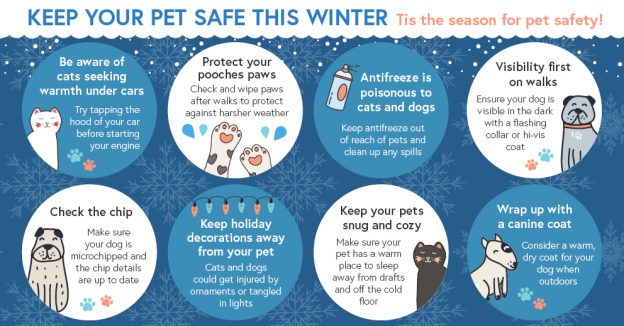
10+ Winter Pet Safety Tips – Keep Your Pets Safe this Winter!

When the weather outside is frightful, keep your pets warm, cozy and delightful with our winter pet safety tips!

With temperatures dropping and wintry weather on the way, our four-legged friends need to be prepared for winter just as much as humans do. We aren’t always aware of some of the added dangers lurking during the colder months, and if left outdoors in the cold for too long – pets can freeze, become disorientated, lost or injured.

Check out some of our winter pet safety tips to help you keep your furry friends safe and warm this Winter:

Prepare your dog for spending time outside, and know their limits

Many dogs enjoy wintery walks in the snow, but it’s important to understand the added risks and take precautions to keep them happy and healthy.

Understand your dog’s limits in the cold

Some dogs are more vulnerable to the colder weather than others. Short-coated, thin, elderly, ill or very young dogs may get cold more quickly. So, make sure you understand your dog’s limits and adjust the time they spend outside to support this.

Prepare your dog for wintery walks  

If your dog enjoys being outdoors and you will be outside for a trip or walk in wintery weather – consider getting them a warm, dry coat to help them stay warm. Make sure you dog is microchipped and the chip is up-to-date and if you find yourself outside during a snowstorm, keep your dog on a leash to ensure they don’t lose their scent and get lost. Not only this, keep your dog visible during evening walks with a hi-vis coat or flashing collar.

Avoid winter puddles or bodies of water when outside with your pet

Frozen or melting ice can pose dangers for your pet. You don’t know whether frozen water can hold your pet, or whether puddles contain ethylene glycol found in antifreeze, which can be fatal if ingested.

Keep your pooches paws in check

After each walk, its important dry your dog’s paws and stomach to remove ice, salt and chemicals. You should also check for cracks in paw pads or signs of irritation.

Don’t forget your indoor dogs

For dogs and other pets who would prefer to stay indoors in colder weather, make sure they’re still getting the exercise and stimulation they need in other ways, for example by playing games indoors.

Be aware of cats seeking warmth under cars

Cats often seek comfort and warmth under vehicles in wintery weather. To avoid injuring cats, make sure you tap the hood of your car to check for cats and get them to move before starting your engine.

Keep your pet’s indoor spaces warm and cosy

You may need to review your pet’s sleeping arrangements during the winter months to ensure they stay warm. Make sure your pet has a place to sleep that is off the floor and away from drafts. A thick, cozy dog or cat bed with a warm blanket or pillow is perfect!

Antifreeze is poisonous to cats and dogs – keep it out of reach!

Antifreeze could be fatal if ingested by pets – make sure you keep it out of reach and you mop up any spills.

Don’t leave your pets alone in a car during cold weather

Just as you should never leave your pets in a hot car, you shouldn’t leave them in a cold car either. Cars can act as refrigerators during the colder months by holding in the cold, which can cause animals to freeze.

Prepare an emergency pet survival kit

You never know when wintery weather might keep you from leaving the house for extended periods, or when you may get stuck on the roads in the middle of a snowstorm. Make sure that your family survival kit includes your pet. Having an emergency supply of pet food, towels and blankets could save your pet’s life in an emergency!

Be alert, and stay safe

If you’re unsure whether it is too cold for your pet outside – it’s worth remembering that, generally speaking, if it is too cold for you, it is too cold for your pet!

Veterinary care support apprenticeship pathway blog image

Don’t miss your opportunity to recruit an apprentice and save up to £3,000!

If you’re a growing business and looking to expand your team, have you considered taking on an apprentice?  

With the National Minimum Wage for Apprentices being just £4.15* per hour, apprenticeships can be an affordable way to take on new staff whilst providing a training opportunity for someone keen to start a career in your industry. 

What’s more – don’t forget that the government are currently offering some additional financial bonuses for employers who hire apprentices 

From 1 August 2020 to 31 March 2021, businesses that recruit a new apprentice aged 16 to 24 will receive a £2,000 incentive from the government towards the cost of training, while those that hire new apprentices aged 25 and over will be paid £1,500. 

These payments will be  in addition to the existing £1,000 incentive training providers already provides for new 16-18 year old apprentices, and those aged under 25 with an education, health and care plan where that applies.* 

This means that if you hire a 16 to 18 year old apprentice in the next 6 months, you could receive £3,000!  If you also have less than 50 contracted employees, the apprenticeship fees for those aged 16-18 years of age will be fully funded! 

Discover more benefits of apprenticeship training 

Time is running out to gain an extra pair of hands for less. Talk to us about apprenticeship training today, before it’s too late! 

In order to claim the incentive payments, your new apprentice needs to have started their contract of employment before 31 March 2021.  

Additionally, if you are a small or medium sized employer (non-levy payer), you need to set up a Digital Apprenticeship Service (DAS) account before you’re eligible for the payment.   

If you’re interested in taking advantage of the financial incentives to recruit a new apprentice, our apprenticeship team can help you set up your DAS account and recruit your new staff member before the deadline. Please contact us directly atfunding@caw.ac.uk or on 01480 422060 for more information. You can alsoview all of our apprenticeship programmes on our website. 

Virtual Careers With Animals Day

Careers With Animals Day is going VIRTUAL!

For those aspiring to an exciting career working with animals, there’s no better place to start than our annual Careers With Animals Day! 

Running as a virtual event for the very first time on Saturday 9 January 2021 (9:30am-5pm), attendees will be able to listen to a jam-packed timetable of careers talks being held throughout the day on careers ranging from veterinary nursing to dog grooming…all from the comfort of their own home!

Running a virtual event means we can welcome people from all over the world to join us from the comfort of their home, using our new virtual conferencing software. Visitors will get the chance to listen to career talks, ask questions and gain advice about how to start a career working with animals. What’s more – attendance is FREE!

Whether you’re a school leaver working out what your next move is going to be, an adult looking for a career change, or unemployed and eager to get back to work – everyone is welcome. The event will run via our new virtual conferencing software on Saturday 9th January, from 9:30am until 5pm and entry is completely free of charge. More information about speakers, and a link to attendance, will be released in the coming weeks.

If you would like to register your interest in the event visit our website or join our Facebook event page.