Author Archives: Amber Tennant

Sadly, staying safe at home isn’t the case for all as domestic violence remains a major concern during the pandemic

Signal For Help

As we are all spending significantly more time at home, it is important to remember that home is not always a safe place for some. Cases of domestic violence during Covid-19 are rising and as a response to this, a new worldwide campaign has been launched called ‘Signal For Help’.

When communicating with anyone online (be that students, staff, family members and friends) be vigilant for this hand gesture –

  • Palm to camera
  • Tuck thumb
  • Trap thumb (making a fist)

This hand sign can be used by anyone who is suffering abuse at home – it is a safe sign that leaves no digital trace and silently communicates to the viewer that help is needed.

Please watch this video to see the sign being used.

https://www.youtube.com/watch?v=AFLZEQFIm7k&feature=emb_logo 

Safeguarding at CAW

If you witness this sign being used by a student, please contact a member of the safeguarding team on Safeguarding contact number 01480 422070 or email: safeguarding@caw.ac.uk.

If you or someone you are with is in immediate danger, do not hesitate to call the police. 

Make yourself heard – What to do if you need urgent police help through the 999 service, but can’t speak?

A national campaign to raise awareness of a system to help people alert the police when they are in immediate danger, but are unable to speak was launched by The Independent Office For Police Conduct on 8 April 2019.

The Silent Solution System enables a 999 caller using a mobile phone who is unable to make any noise or speak, to press 55 when prompted. Then the police will be informed they are in a genuine emergency. You can find out more about this here.

Resources

Remember, you don’t need to wait until you or others are in immediate danger or in an emergency situation to seek help.

Further sources of help and support for those at risk can be found at:

Self care week

10 Simple Self Care Ideas to Boost your Wellbeing

Now more than ever, it’s really important to take the time to look after your emotional and mental wellbeing.

Many of us are facing more social and economic pressures. You may be feeling the pressures of working or studying whilst trying to maintain a positive balance at home. There may be anxieties over COVID-19, or concerns over vulnerable loved ones during this time. Some of us may be faced with uncertainty over finances and changes in the economy and future job security.

With this in mind, we urge our students, along with our wider community, to make time for self-care and research self care ideas that may work for them. Healthy living isn’t just about what you eat for dinner or how often you’re in the gym. It’s about taking time out to focus on yourself to boost your emotional and mental wellbeing.

This self-care week, take a look at these ten simple self care ideas that you can use to boost your wellbeing, which don’t take up a lot of time and can slot into busy routines more easily:

  1. Watch the sunrise or sunset

Any time you can make in your life to pause and simply breathe is a good way to boost mental wellbeing. Making a point to watch the day begin and end each day is a perfect way to slow down. What’s more – you can enjoy the sunlight at its most colourful! (Don’t take any pictures or post about it on social media, just watch!)

  1. Take a leisurely walk

A short walk around the block or your local park in the fresh air can help clear your mind of worries or distractions, and just focus on the ‘here and now’ for a while. Remember to follow the latest guidance from the government in regards to social distancing.

  1. Listen to a feel-good playlist or podcast

Wind down from a busy day by listening to your favourite songs, or a short podcast on a topic that interests you.

  1. Read a book

When was the last time you read a good book? If you can’t remember, you’re not alone – many people struggle to find the time to read. However, sitting down with a book even for just five minutes can help to reduce stress and keep your mind stimulated. If you’re looking to revitalise a love of reading, why not take a look at Amazon’s 100 Books to Read in a Lifetime?

  1. Declutter your house or wardrobe

Taking the time to clean up a cluttered area that has been bothering you for a while, or give away clothes you don’t really need, can help you feel more organised. As they say, a tidy home equals a tidy mind!

  1. Write a journal entry

Writing can be a fun past time to inspire creativity and help you to organise your thoughts to boost self-reflection. You could write about your feelings, experiences and thoughts about your day; or pick from one of the thousands of diary prompts available online.

  1. Try meditation

Meditation is a simple method to focus on the present moment. The mental health benefits of meditation include better focus and concentration, improved self-awareness and self-esteem, lower levels of stress and anxiety, and fostering kindness.

  1. Take a day away from social media and the news

Between the news and social media, we’re all feeling saturated by coronavirus updates right now. It’s important to stay informed, but too much exposure can increase feelings of fear and anxiety. Try to limit your media intake to a couple of times a day and use trusted news sources. If you catch yourself turning to social media because you’re feeling isolated, take a break and spend time on another activity.

  1. Learn something new

Have you ever wanted to get into drawing or learning a musical instrument? Now’s a great time to make a start and there are free resources available for all kinds of hobbies. YouTube has great free online tutorials for pretty much everything. We also offer a range of online, distance learning programmes.

  1. Call a friend or family member

We’re all doing our best to adapt to a new way of living, so now more than ever we need to check in with others. There’s a lot of comfort to be found in simply having a catch up with a loved one. 

If it’s all getting a bit much…

Sometimes things can get overwhelming, even if you’ve been practising self-care. If it’s available to you, you should consider seeing your GP or mental health professional for extra help. You could also ask your mental health professional if they could chat over Skype/FaceTime if you’re in self-isolation.

Further mental health support at The College of Animal Welfare

Mental health and wellbeingIf you’re a student or staff member with us, and you’re struggling with your mental wellbeing, please don’t hesitate to reach out to your teacher, head of course or line manager – they are there to help and support you.  We also offer lots of additional mental health support that you can access free of charge:

Togetherall

All staff and students can now access free online mental health and wellbeing support through Togetherall (previously called Big White Wall). This service can be used at any time of the day or night, all year round.

Whether you’re suffering from stress, problems with sleep, feeling low or unable to cope, or simply need someone to talk to, Togetherall can help you get support and learn useful coping strategies to improve mental health and wellbeing. The service enables members to get things off their chest in a safe, anonymous global community. You can access a library of self-care resources and trained professionals are online 24/7 to keep all members safe and provide extra support.

The college will not be informed of those who are signed up to Togetherall or activity on the service unless they are seriously concerned about safety whilst on campus. To join, go to the Togetherall website and sign up under ‘I’m from a university or college’ using a staff or student e-mail address.

College counselling services

In addition to this, we offer a confidential counselling services, with free sessions for students on an ongoing basis (the college is not made aware of any appointments made). The College counsellors are still available via phone, email or video conference:

Jill Dighton | Tel: 07925 852 985 | Email: jill@jdighton.co.uk

Mark Walsh | Tel: 07905 611 591 | Email: mwalsh4@sky.com

Mental health resources

How to cope with zoom fatigue

It’s not all Zoom and Gloom: How to Cope with Video Call Fatigue and Anxiety

How to overcome video call fatigue and anxiety

Microsoft Teams, Zoom, Google Hangouts, FaceTime – for many of us, working and studying from home during the COVID-19 pandemic has meant video call apps have become essential tools in our lives, allowing us to attend classes and stay in touch with classmates, colleagues, friends and family.

Video calling has made it possible for us to continue to study, learn, work and communicate in innovative ways. However, it doesn’t come without its challenges…

On a video call we need to work much harder to process the nonverbal signals we can interpret effortlessly face-to-face. Not only this, we need to place more energy into conveying our interests, feelings and enthusiasm.

For some, these novel pressures to “perform” socially or in a school/work setting via video conference can lead to feelings of video call fatigue, burnout or anxiety. If you’re struggling with video calling, you’re not alone. Here, we’re discussing some of the ways you can overcome these feelings to ensure you make the most of your online interactions – whether you’re attending an online class, a work meeting or a catch up with your friends. Let’s make a start:

Suss out the technology

Get a handle on technology to beat video call fatigue

Technology has created innovative ways for us to stay in contact; however, the frustrations that come with setting up and holding video calls can sometimes cause video call fatigue, anxiety or discomfort. For example, people turning their microphones on and off, lagging connections, and background noise mean meetings don’t always run smoothly.

You can avoid these frustrations by making sure you have a strong and consistent internet connection. You should also make an effort to really understand the technology you’re using and the features available to improve your experience. By doing this, you’ll also avoid rookie errors that come with online communication, such as sharing the incorrect screen to your teachers/classmates, or accidentally sending the wrong message into a group chat.

Make use of pre-made backgrounds

Many video calling applications such as Microsoft Teams offer lots of fun patterns and landscapes that you can place to block out your background on camera.

This light-hearted feature can be a simple fix to many of the novel anxieties that come with going to classes or meeting your colleagues from home. For example, you won’t need to worry about your remote workspace and showing something that makes you look bad to our colleagues or classmates. Equally, there will be no need to fret about your kids or family members bursting into the room at any moment and distracting the call.

Get comfortable with being on camera

Get comfy being on camera

For people who worry about their appearance or behaviour on camera, being forced to look at your own face on screen for a whole class or meeting can increase video call fatigue or anxiety.

To minimise this feeling, you could hide self-view once you’ve turned on your camera and checked your lighting is ok. Others will see you, but (as in real-life) you won’t constantly be reminded of that fact. This can help you to feel less self-conscious.

If you’re shy on camera, there are ways you can try to get used to it in small doses. For example, you could turn on your camera when you join a meeting so others can see you and “know” you’re there, and then turn it off. Some people prefer to turn their camera off when they’re not speaking, but turn it back on when they are. If you’re a student, it’s also worth having a conversation with your teacher or lecturer, as they’ll be able to provide you with some extra support and guidance.

In these days of increased isolation, it’s important to remember being on camera is one of the few ways we can physically see each other, and a key way for the people that care for us (teachers, friends, family) to see that we are ok.

Mix up your communication methods

Limiting the number of video calls you make in one day can help reduce fatigue. Whilst some video calls are essential and everyone needs to show up if they are expected to be present (for example, a group class, lecture or seminar) there may be other instances where you can communicate in other ways. In this respect, it is worth having a think about where you can opt for other forms of communication, and have those conversations to see if this is possible. For example, sometimes using a shared document platform to make detailed collaborative notes can reduce the need to meet. Additionally, you could use instant messenger, email or speak on the phone instead.

Apply face-to-face meeting rules to boost efficiency and reduce fatigue and anxiety

Online learning from home

The COVID-19 pandemic may have put a halt to face-to-face meetings for a while, but that doesn’t mean we can’t bring the principles of regular meetings and classes into our video calls. Take note of these snippets of advice:

Be prepared for your video call

Preparing in advance can help you feel more confident on the day. You could do this by writing down some things to say to questions you think might come up, having some notes you can rely upon if you need them, or even perhaps rehearsing what you’re going to say.

Practice methods for controlling anxiety in the moment

Combat video call fatigue and anxiety in the moment by using positive self talk such as “I can do this” “I know what I’m talking about” and focusing on your breathing to calm down.

Have meetings with purpose

Video calls drag on when there is no understanding of what you need to accomplish. For any calls you hold, make sure you identify a clear purpose for the meeting. You should also secure an agenda of what you’ll cover. This way, the calls will be more efficient and productive.

Scheduling short calls is ok

It’s much better to have a 10-15 minute call where all participants are positively engaged, rather than spend an hour on a call with people who are clearly distracted or uncomfortable. In this sense, sometimes a quick catch up may suffice!

Schedule breaks

Having back-to-back video calls means you have no time for a mental, visual, or physical break. Think back to in-person meetings. Even when they’re back-to-back, you usually have small breaks to grab a drink or switch rooms. You need those same breaks to reenergize when working remotely too.

Reach out to others and talk about your worries, and seek extra help and support if you need it

Mental health and wellbeing

It’s a universal truth that a burden shared is a burden halved. We’re all doing our best to adapt to new ways of communicating. It’s likely that the other people in your classes or meetings may be going through similar experiences, feelings and worries. There’s a lot of comfort to be found in simply airing your troubles to others. This way, you can talk about how you can overcome shared problems together.

We’re living in unprecedented times, and mental health has never been more important. It’s ok to reach out for further help and support if you need it. There are so many people, organisations, services and resources out there to help you cope during difficult times.

If it’s available to you, you should consider seeing your GP or mental health professional for extra help. You could also ask your mental health professional if they could chat over Skype/FaceTime if you’re in self-isolation.

Further mental health support at The College of Animal Welfare

If you’re a student or staff member with us, and you’re struggling with video call fatigue or anxiety, please don’t hesitate to reach out to your teacher, head of course or line manager – they are there to help and support you.  We also offer lots of additional mental health support that you can access free of charge:

Togetherall

All staff and students can now access free online mental health and wellbeing support through Togetherall. This service can be used at any time of the day or night, all year round.

Togetherall can help you get support and learn useful coping strategies to improve mental health and wellbeing. The service enables members to get things off their chest in a safe, anonymous global community. You can access a library of self-care resources and trained professionals are online 24/7 to provide extra support.

The college will not be informed of those who are signed up to Togetherall or activity on the service unless they are seriously concerned about safety whilst on campus. To join, go to the Togetherall website and sign up under ‘I’m from a university or college’ using a staff or student e-mail address.

College counselling services

In addition to this, we offer confidential counselling services, with free sessions for students on an ongoing basis. The college is not made aware of any appointments made. The College counsellors are still available via phone, email or video conference:

  • Jill Dighton | Tel: 07925 852 985 | Email: jill@jdighton.co.uk
  • Mark Walsh | Tel: 07905 611 591 | Email: mwalsh4@sky.com

Mental health resources

 

How to Manage Stress During Coronavirus

Feeling stressed is a completely normal response to the current coronavirus pandemic.

You might be stressed about catching the virus, about your finances, about how your loved ones are coping, or about the disruption to your work, studies and routines. Not only this, we’re also dealing with the disappointment and stress that comes with travel bans, events being cancelled and social lives being put on hold.

This National Stress Awareness Day, we want to encourage you to be proactive and learn more about how you can manage stress during coronavirus if you’re struggling to cope. Read on to learn more:

Hold on to habits that make you feel in control

How to manage stress during coronavirus

Holding onto the little things that add something reliable to your life is really important during times where there is plenty of disruption that could overwhelm us (for example, at school, home, university/college or work). It can also help to reassure you that everything will be ok, especially when you’re feeling like things are spinning out of control.

Some examples of routines or rituals that could help you stay grounded include:

  • waking up at the same time every day
  • eating regular meals
  • going to bed at the same time
  • doing some form of exercise every morning
  • reaching out to a friend each day

Accept that it’s normal to be feeling stressed and give yourself credit where it’s due

Feeling stressed is a completely normal response to the current coronavirus pandemic, because there’s so much about it that’s outside of our control. Not just the spread of the virus itself and the uncertainty it brings, but all the other aspects of our lives that have changed as a result: from big shifts in the workplace and worries about money, to restrictions to travel and the social lives we rely on to stay connected to our loved ones. So much change and unpredictability is stressful.

Rather than giving yourself a hard time, remember to give yourself credit for living through such a tough period, and recognise that by dealing with all these challenges you’re becoming a stronger and more resilient person. As hard as things are, there is also a lot of comfort to be found in the simple knowledge that you’re not alone and others are experiencing the same feelings. When you check in with your loved ones, make sure to share how you’re feeling and check in on their wellbeing – it’s likely you’ll find they’re in the same boat as you. 

Take practical steps to change your mind set and boost your resilience towards stress

Take practical steps to manage stress

Confronting the source of your stress and uncertainty is empowering. The first step to feeling more prepared to cope is to identify the causes of your stress and then think about how to find a solution:

Practice tolerating uncertainty

You can strengthen your response to stress by boosting your tolerance towards uncertainty or situations where your sense of control is removed. You can start by doing small things differently. For example, you could pick a random show to watch without knowing anything about it, or drive/walk a different route to the shops.

The idea is to learn that not everything will work out how you wanted it to, but if even things don’t always go as planned, you can still deal with them. Try to focus on the things you can control, rather than on the things you can’t. Once the event has passed, you can’t change it so try to move on and focus on the future.

Try to think about stress differently

Rather than viewing stress as something that’s bad, why not think of it as your body’s way of preparing you for the situation you’ve been put in? If we perceive stress as something positive which is helping us, it may not have the same power over us. In her TED talk, Kelly McGonigal presents the theory that the way we think about stress is what determines if it has a negative impact on our health. She explains that if we perceive stress as something positive which is helping us, it may not have as much of a negative impact.

Prioritise your workload

Having lots of work hanging over your head can be daunting and stressful on top of the added stresses the pandemic brings. Taking the time to prioritise your workload can help to make it more manageable. This will help you to get the work you need to get done without the panic of rushing to get it all done at once. Rather than working harder, prioritise your activities and leave the least important task for last. It can be empowering to accept that your to-do list may never read “zero” at the end of the day…and that’s ok! 

Stay up to date with the facts

Stay up to date with factual news

With constant updates from the government, media outlets and social media, it’s natural to feel like you’re being saturated by coronavirus updates right now. It’s important to stay informed, but too much exposure can increase feelings of stress, fear and anxiety – especially if you’re not seeking information from trusted sources.

By choosing trusted news sources, you’ll provide yourself with more certainty about what’s happening and you’ll be less likely to get overwhelmed by coverage.

If you catch yourself turning to the media all the time, you may wish to limit your media intake to a couple of times a day to make sure you’re not overwhelming yourself. Along similar lines, if you catch yourself turning to social media all the time because you’re feeling isolated, take a break and spend time on another activity.

Some good news resources include:

Make your physical and mental health a priority

How to manage stress during coronavirus

Having a healthy lifestyle can sometimes be difficult for those of us who are always rushed for time. It is especially difficult if you are feeling stressed and anxious about the future. But eating a well-balanced diet and exercising regularly can help to clear your head. Fueling your body with the right foods can also boost your energy, helping stressful tasks seem more achievable.

Stay connected to friends and family

However overwhelming your life may feel, or how busy your schedule is, spending time with friends and family is important – even if this has to be virtually. As well as giving you a break from the strains of everyday life, socialising can help to reduce stress by focusing your mind elsewhere. Family and friends can also be a great support network and can be there to offer advice should you need it.

Be more mindful

Be aware of your thoughts and feelings, and when your thoughts take over the present moment. Remember these are simply thoughts that do not need to control us. Be aware, even as you about your daily routine, by appreciating the journey to work or taking a lunch time walk.

If it all feels too much, seek help and support

How to manage stress during coronavirus

We’re living in unprecedented times, and mental health has never been more important. It’s ok to reach out for further help and support if you need it. There are so many people, organisations, services and resources out there to help you cope during difficult times.

If it’s available to you, you should consider seeing your GP or mental health professional for extra help. You could also ask your mental health professional if they could chat over Skype/FaceTime if you’re in self-isolation.

Further mental health support at The College of Animal Welfare

If you’re a student or staff member with us, and you’re struggling with stress, please don’t hesitate to reach out to your teacher, head of course or line manager – they are there to help and support you.  We also offer lots of additional mental health support that you can access free of charge:

Togetherall

All staff and students can now access free online mental health and wellbeing support through Togetherall (previously called Big White Wall). This service can be used at any time of the day or night, all year round.

Whether you’re suffering from stress, problems with sleep, feeling low or unable to cope, or simply need someone to talk to, Togetherall can help you get support and learn useful coping strategies to improve mental health and wellbeing. The service enables members to get things off their chest in a safe, anonymous global community. You can access a library of self-care resources and trained professionals are online 24/7 to keep all members safe and provide extra support.

The college will not be informed of those who are signed up to Togetherall or activity on the service unless they are seriously concerned about safety whilst on campus. To join, go to the Togetherall website and sign up under ‘I’m from a university or college’ using a staff or student e-mail address.

College counselling services

In addition to this, we offer a confidential counselling services, with free sessions for students on an ongoing basis (the college is not made aware of any appointments made). The College counsellors are still available via phone, email or video conference:

Jill Dighton | Tel: 07925 852 985 | Email: jill@jdighton.co.uk

Mark Walsh | Tel: 07905 611 591 | Email: mwalsh4@sky.com

Mental health resources

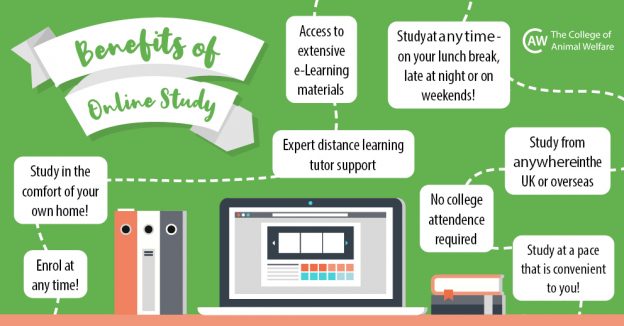
Online Learning Benefits Infographic

Why Study Online? 10 Benefits of Online Learning

For those looking to undertake further training or learn a new skill, the growth in online learning options means it’s now possible to study a range of subjects from the comfort of your own home. And what’s more – there are many unique benefits to doing so!

Check out just a few of the benefits of online learning…

1. Enjoy the flexibility that comes with online study

One of the main benefits of online learning is that you have the freedom to set your own study routine, because you aren’t tied down to a fixed schedule.

This means you can shape your programme around your existing commitments! Imagine having complete control over when, where and how you study – that’s exactly what online learning gives you…

          2. Study at any time

Night own or early bird? Studying online means you can study whenever you want – on your lunch break, late at night, early in the morning or even at weekends!

         3. Study anywhere

No college attendance is required for distance learning programmes meaning you can often study from anywhere – at home, at work, on the train, in the UK or even overseas!

         4. Learn at your own pace

Online learning means you can study by your own rules, without the pressure to keep up with other students in a face-to-face environment. You may pick up some lessons easily, whereas you might need extra time to understand other concepts. Either way, you can manage your time accordingly to ensure your optimal progress through the course.

5. Benefit from expert, one-to-one distance learning tutor support

Many online programmes offer remote support from tutors with a wealth of industry experience and skills to help you achieve your full potential on the course.

Often in classroom-based courses, the tutor teaches and provides support to a group of students, with some students sometimes demanding more time and attention than others.

With some online learning programmes, remote support means you may receive more personalized, one-on-one help. What’s more – often you can access help via a range of methods including telephone, skype and email at shorter notice. This increases the chances of you performing well, as you can easily access tutor advice and guidance when you’re stuck.

6. Cut your training costs

Studying a course online allows you to save money on all the associated costs that come with classroom-based learning. You won’t have to pay for on-campus accommodation or textbooks, arrange for childcare cover in order to attend classes, or spend money commuting to physical classrooms. Fuel, parking, car maintenance or public transportation costs won’t affect the online student!

7. Find your online communities

Online learning doesn’t mean you have to study alone! You can still gain the community face-to-face learning gives you by studying remotely with others, either by joining online communities that focus on common subjects, or contributing to course discussion forums.

Remote collaboration requires no more than a computer, a headset to listen and talk in, and the time to join others virtually. You can swap ideas about classroom assignments; brainstorm using virtual whiteboards and get questions answered about the things you’re stuck on.

Not only this, but the world goes way beyond a physical classroom! Online learning opens up the opportunity to network with fellow students from across nations or even different continents.

8. Boost your career prospects

Without the structure of face-to-face classes to keep your study routine on track, in order to effectively manage your time and tasks you will naturally develop the soft skills and traits that employers look for, including self-discipline, self-motivation and time management!

Undertaking an online course can also help you learn the skills needed to gain a promotion or change careers without neglecting your existing professional commitments and aspirations.

9. Get ahead with the most varied and up-to-date learning materials, accessible 24/7

One of the other great benefits of online learning is that you’ll often get to learn using a range of different materials and resources – from videos and webinars, to quizzes, podcasts and presentations. Additionally, as knowledge of certain subjects continues to grow and evolve, paper textbooks can become unreliable. With online learning, the course developers and instructors are able to keep materials up-to-date more easily.

What’s more – as all course materials are provided online, you can access them whenever you want. Even if it’s 3AM, if you want to access your materials to reinforce concepts and theory you might be stuck on – you can do that. It’s also much easier and quicker to find relevant sections and take notes via online navigation.

10. Receive the same kudos as traditional learners

If the course you decide the study offers both an online and a face-to-face option, don’t make the mistake of thinking your choice will impact the value of the final qualification. Whether you choose the distance learning or face-to-face option, you will be provided with the necessary resources and materials needed to succeed, and the value of the qualification at the end of your studies will be the same.

Boost your professional skills and meet your career goals from the comfort of home, with flexible online learning

If you’re keen to boost your professional skills, don’t let the coronavirus pandemic stop you from meeting your goals…why not study online? With many of us spending more time at home, now could be the perfect time to learn something new.
 
Our online, distance learning programmes can help you gain the skills and experience needed to launch a career working with animals, without having to attend college. You can start the courses at any time, learn at your own pace and study from anywhere. We also offer a number of business and accounting courses which can be studied remotely. Learn more about our distance learning programmes on our website. 
Black Cat Day Image

Black Cat Day: 5 Top Tips for Photographing Black Cats

Today is Black Cat Day!

Did you know that black cats are less likely to be adopted than cats of any other colour/s?

Rehoming statistics from the RSPCA show that black, and black and white, cats are more frequently seen in their centres, and they also take longer to find their ‘furever’ home. 

Part of the reason for their struggle is that many people still associate black cats with witchcraft and bad luck. In the age of Instagram and selfies, they have also faced an added challenge: some see black cats as less aesthetically pleasing than their more colourful furry friends on camera, and more difficult to photograph!*

We completely disagree! Black cats are beautiful; and they can photograph just as nicely as any other pet. Whether you’re a black cat owner, work in a rescue centre or you’re considering adopting a cat in the future; here are some top tips on photographing black cats:

  1. Pick the right time of day

Time of day is crucial to taking a good photograph of a black pet. A great time of day to shoot is the hour just before the sun sets (otherwise called the golden hour). This is because the sun is low in the sky and the light is much softer. Alternatively, you could take photographs on cloudy days so that you cat is more evenly lit. Avoid using flash if you can; although it may be tempting to use flash with a darker pet, this can often create a strange green eye effect!

  1. Choose a good background

The right background colour is especially important when you’re taking a photo of a black cat. Ideally, you’re looking for good contrast colours that complement black well. For example, if you get down low you could shoot upwards and get the blue sky as your background, as blues contrast nicely with black fur.

  1. Capture your pet’s eyes

Capturing dark eyes against dark fur can sometimes be difficult, however one way to achieve this is to hold something near to the camera, such as a toy, and shooting from above if your cat has lots of fur. This will allow the fur to fall back away from the eyes. Plus, it can be very cute angle! 

  1. Take a silhouette photograph

Have you thought about taking a silhouette photograph? Black cats will suit this fantastically as, after all, they’re black! The best way to shoot is with the sun behind your cat, during the golden hour at dawn or dusk.

  1. Go outside

If your house isn’t particularly well lit, you may find your cat looks like a black blob when you photograph them. If this is the case, follow the natural light and go outside.

Remember, practice makes perfect and trial and error is your best friend. Find what works for you and your cat, run with it, and you’ll be taking fantastic photographs in no time! If photography is a passion or hobby for you, you could even consider studying a pet photography course as a fun way to boost your skills.

Hand on a horse

Study Equine Veterinary Nursing with us this Spring

If you’re passionate about horses and searching for a job doing something you love, we’re pleased to say applications are open to study Equine Veterinary Nursing with us this February!

Our Level 3 Diploma in Equine Veterinary Nursing will teach you the clinical skills and knowledge needed to prepare you for a successful career as an Equine Veterinary Nurse.

Discover all the key facts about the Level 3 Diploma in Equine Veterinary Nursing…

  • Two year course
  • Four x two week blocks at college per year
  • Study from Huntingdon, Cambridgeshire
  • Employment in an equine or mixed veterinary practice required
  • Apprenticeship option available

Download the course infographic to learn more

Gain advice for finding employment in an equine veterinary practice

If you’re interested in studying equine veterinary nursing with us, you may have noticed that entry onto our Level 3 Diploma in Equine Veterinary Nursing programme requires you to have secured employment within an equine or mixed (small animal and equine) veterinary practice that is an RCVS approved TP or aTP. Check out our tops tips and advice for finding work

Learn more about the job role and career progression

Equine veterinary nurses are key members of the veterinary team, providing care and treatment to horses every single day. Download our free careers booklet to learn more about the job responsibilities and career development opportunities.

How we can support veterinary practices during COVID-19

At The College of Animal Welfare, we offer a variety of training options and support for businesses in the veterinary and animal care field, and we’re doing all we can to continue to support employers throughout what is a period of immense change. 

As the COVID-19 pandemic continues to present staffing, recruitment and training challenges for many veterinary practices, we wanted to outline some of the ways in which we can support veterinary practices during this time. Let’s take a look: 

Veterinary Nurse Training

As one of the UKs largest and most establish veterinary nurse training providers, we can help you recruit and train loyal, professional and highly qualified veterinary nurses. If you’re looking to recruit a student veterinary nurse in the near future, there’s still time to recruit in time for our next Level 3 Diploma in Veterinary Nursing intake starting in January. Equally, applications are also open for start dates in April and September 2021, leaving plenty of time to plan ahead. If you would like to discuss your training or recruitment needs, please don’t hesitate to contact us.

Veterinary Nursing Apprenticeships

Our Level 3 Diploma in Veterinary Nursing programme is also available for student veterinary nurses to undertake as part of an apprenticeship. As 95% of apprenticeship training fees are covered by the government for small employers, and the National Minimum Wage (NMW) for apprentices is only £4.10*, recruiting an apprentice veterinary nurse could be an affordable way to grow your practice team in the coming months.

Taking on an apprentice is more cost effective than usual at the moment, as the government has recently introduced some new financial incentives for employers recruiting apprentices in the next 6 months. You can read more about these incentives here. More than this, if you choose CAW as your training provider we can help you recruit free of charge.  

If you are considering recruiting an apprentice veterinary nurse, either for a course intake coming up this September or in the near future, please do get in touch with us for an informal chat about the process on 01480 422060 /admin@caw.ac.uk You can read more about apprenticeship training and what we can offer at CAW on our website. 

Veterinary Nursing Student Placement Scheme

Your practice may not be in a position to recruit student veterinary nurses at the moment. If so, have you considered taking on a student veterinary nurse for a short, unpaid work placement to fill any staffing gaps? We have diploma and degree level student veterinary nurses looking for unpaid work placements in veterinary practices across the UK. There are a number of benefits to taking part in the scheme:   

  • Your practice could be eligible for free training practice approval and clinical coach training
  • All work placements are unpaid
  • You interview the student beforehand
  • There’s no need for extra insurance
  • You could keep your student for up to two year
  • Quick and simple to record your student’s experience with the online Nursing Progress Log (NPL) or ePortfolio
  • Upon qualification you could even find that your student becomes your next loyal qualified RVN!

You can read more about our practice placement scheme here  

Training Practice Approval

If you are a veterinary practice looking to become involved in veterinary nurse training, we can help you achieve this.

You will need to be approved as either a Training and Assessment Practice (TP) or an Auxiliary Training and Assessment Practice (aTP) by an Royal College of Veterinary Surgeons (RCVS) approved Primary Centre.

In March 2001 The College of Animal Welfare became the first Veterinary Nursing Approved Centre (VNAC) to be appointed by the RCVS, and have since become the largest Primary Centre in the UK supporting over 300 practices. Find out how to become a Training Practice.

Bespoke Training and Consultancy

We have worked with many of the UK’s leading animal welfare organisations for a number of years, providing bespoke training, eLearning solutions and consultancy to support organisations with their staff training needs. Find out how bespoke training and consultancy could work for you.

Contact us to discuss your training and recruitment needs

Here at CAW, we are doing all we can to continue to provide quality teaching and support employers and businesses throughout what is a period of immense change. You can read more about our response to COVID-19 on our website. If you have any queries about veterinary nurse training, or if there’s anything we can do to help support your practice during this time, please don’t hesitate to get in touch with us on 01480 422060 or email us at admin@caw.ac.uk  


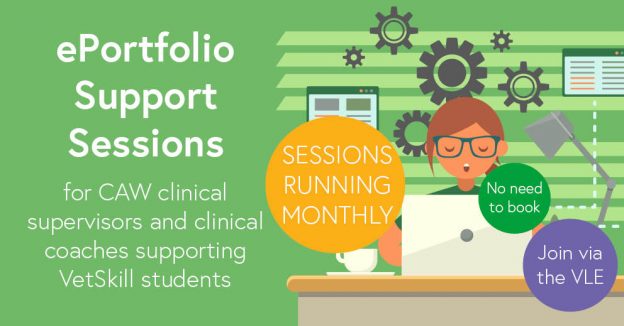
eportfolio support sessions monthly2

ePortfolio Support Sessions for CAW Clinical Supervisors

We are pleased confirm that we will be running monthly ePortfolio support sessions, for CAW clinical supervisors who are supporting VetSkill students! These sessions will be delivered via our new virtual learning platform, and will take place on:

  • Wednesday 14th October at 2pm
  • Thursday 12th November at 9.30am
  • Wednesday 16th December at 2pm
  • Thursday 14th January at 9am

Each session will include a presentation explaining the resources available on the VLE and an overview of the ePortfolio. You will also have the opportunity to ask questions in the live chat and participate in live polls throughout the sessions, making them even more interactive and informative!

If you would like to attend a session, you need to ensure that you have access to the Clinical Coach Standardisation area of the VLE, which can be applied for via the CPD area of the CAW website at https://cpd.caw.ac.uk/clinical-coach/standardisation/.  Once the application form has been processed, you will receive an email to confirm you have access. We would advise you do this as soon as possible, if you do not already done so, to allow us time to approve your application.

There is no need to book just simply join the session via the “Live Session Updates” section of the Clinical Coach Standardisation Area on the VLE at your preferred date/time. If you haven’t already done so, check you have access to this area, and complete our virtual learning platform training, before the session at https://vle.caw.ac.uk/course/view.php?id=1538

Starting a course during covid

Advice for students starting a course at college or university during COVID-19

As many students return to college or start their studies at university for the first time this month, we want to provide some reassurance and advice for students who may feel nervous about starting their course during a pandemic.

Here, we’ve collated some advice and guidance for our students about what they can do to make learning during a pandemic as seamless as possible. Let’s get started:

Remember your safety basics

covid safety rules

This has been a year like no other and being in a pandemic means that your experience as a student will be different. It’s natural to have concerns about staying safe and questions about how restrictions will impact on you as you start college or university.

If you’re unsure of what the procedures will be, the first thing to do is check your college or university website or information that has been sent to you. At The College of Animal Welfare, we’re doing all we can to continue to provide quality education to ensure students can make a successful and seamless start to their courses this year. To keep up-to-date with all of our COVID-19 updates, activities and policies make sure you visit our COVID-19 page.  

Additionally, make sure you stay informed about the latest government advice and remember your safety basics: wash your hands regularly, wear a face covering in enclosed spaces and stay at least 2 metres apart (or 1 metre with a face covering or other precautions.) Visit the government website for updates

Look after your mental health, ask for help when you need it and understand what support is available

Mental health and wellbeing

As a College, the wellbeing of our students is at the forefront of everything we do. So, we want to make sure that in this time of uncertainty, you still feel supported and know that we are available to offer you any guidance we can.

Togetherall

All staff and students can now access free online mental health and wellbeing support through Togetherall (previously called Big White Wall). This service can be used at any time of the day or night, all year round.

Whether you’re suffering from stress, problems with sleep, feeling low or unable to cope, or simply need someone to talk to, Togetherall can help you get support and learn useful coping strategies to improve mental health and wellbeing. The service enables members to get things off their chest in a safe, anonymous global community. You can access a library of self-care resources and trained professionals are online 24/7 to keep all members safe and provide extra support.

The college will not be informed of those who are signed up to Togetherall or activity on the service unless they are seriously concerned about safety whilst on campus. To join, go to the Togetherall website and sign up under ‘I’m from a university or college’ using a staff or student e-mail address.

College counselling services

In addition to this, we offer a confidential counselling services, with free sessions for students on an ongoing basis (the college is not made aware of any appointments made). The College counsellors are still available via phone, email or video conference:

Jill Dighton

  • Tel: 07925 852 985
  • Email: jill@jdighton.co.uk

Mark Walsh

  • Tel: 07905 611 591
  • Email: mwalsh4@sky.com

Mental health resources

Meet new friends and connections, even if virtually

Build friendships

Part of the joy of college or university is studying with like-minded people and making friends for life. So, when socialising is legally restricted, it’s only natural to worry about how you’re going to do this. However, learning in a pandemic doesn’t necessarily mean learning in isolation.

At The College of Animal Welfare, we will endeavour to provide some face to face and online tuition during the autumn term and potentially into 2021, whilst maintaining social distancing requirements. In the meantime, we have prepared a range of appropriate induction activities to help you settle into college life and meet your new classmates.

Additionally, our new online virtual classroom software offers lots of interactive features which means you can engage with your tutors and peers in real-time during teaching sessions, for example through sharing of emoji icons, polling, and breakout rooms. Our lecturers provide remote academic support, such as small group meetings and learner reviews. This means there will still be plenty of opportunity to make new friends and enjoy the interaction that makes college such an exciting and rewarding experience.

Remember to stay connected to existing friends and loved ones too

Starting university or college can be nerve wracking, and starting during a pandemic can present more challenges than usual. So, it’s really important to stay connected to those who care about you, and can support you when you need it. 

Make the most of online learning

Online learning from home

You can make the most of online learning by participating actively in online discussions and group activities and offering your input into lessons. You can also the text chat facilities if you’re more comfortable expressing yourself in this way.

At The College of Animal Welfare, there is plenty of opportunity to get involved in your course and build friendships with your classmates. Connecting with your classmates on social media or our new online virtual classroom software, will help to boost your e-learning experience.

Online learning offers many unique benefits, however it’s important to be mindful of your behaviour online. Make sure you maintain a polite tone, be respectful when discussing topics with other members of your online group, and always write in clear sentences to avoid misunderstandings.

Take steps to stay motivated and happy learning from home

It can be challenging to maintain the same levels of motivation while working or studying at home, compared to if you were at work or college. That’s why we’ve put together some tips to help you stay focused while working at home:

  • Have a designated space for your college work that is free from distraction and has all the materials you need to study with ease. You could also decorate your study space with inspirational quotes and pictures to boost motivation.
  • Keep in contact with your tutors and fellow students to discuss your college work and help each other with problems and concerns you may be having.
  • Make sure you take regular breaks and take the time you need for self-care and boosting your mental and physical wellbeing (for example, take time out to eat a proper lunch and do some exercise such as a walk).
  • Come up with a study schedule that works for you and takes into account your responsibilities, for example your virtual lessons or tutorials.
  • Accept that you won’t always have productive days, and sometimes tasks are best left for tomorrow.
  • Stay in routine as much as you can. For example, waking up and going to bed at the same time on weekdays as you would if you were going to work or college can help to add consistency to your daily routine.
  • Set yourself a to-do list, or create a timetable to help add structure to your day. Having clear goals can also help you to stay focused and motivated with the work you’re doing.

Embrace change and stay positive

Learning during a pandemic will always present challenges. More so than ever, it’s really important to embrace change, remain positive and reach out for support if you need it. If you are worried, unsure or have any questions about how your course is progressing, don’t hesitate to make contact with your college or university to help put your mind at ease.