Author Archives: Amber Tennant

Suicide awareness and prevention

Suicide Awareness and Prevention: Supporting Yourself and Others

In the UK and Ireland alone, over 6,000 people died by suicide in 2018.*

If you’re feeling like you want to die, it’s important to reach out for help in any way you feel comfortable doing so.

It’s crucial to remember that you don’t need to struggle with difficult feelings alone; help and support is available right now if you need it.

Here are just some of the different ways to get help:

  • Talking with a close friend or family member you trust  
  • Calling or texting the Mind Infoline on 0300 123 3393 or text 86463
  • Calling a hotline or helpline –
    • Samaritans is available for everyone, 24/7 on 116 123 / samaritans.org
    • Campaign Against Living Miserably (CALM) is available for men from 5pm-Midnight every day on 0800 58 58 58 / Webchat
    • Childline is available for children and young people under 19 on 0800 1111
  • Scheduling an appointment with a professional therapist, or e counselling if that is more appropriate. Staff and students at CAW can access counselling on an ongoing basis, further information can be found the student support section of our website.
  • Reading others’ stories of hope and recovery. Sometimes reading how others have made it through tough times can help you navigate your own situation
  • Joining a support group (Find your nearest Mind centre here)
  • Calling your GP and asking for an emergency appointment
  • Calling 111 out of hours – they will help you find the support and help you need
  • If you have one, contact your mental health crisis team

If your life is in serious danger, for example if you have taken a drugs overdose, call 999 for an ambulance or go straight to A&E, or ask someone else to call/take you to A&E.

If you’re struggling to cope in the moment, try not to think about the future – just focus on getting through today. Try to be around other people and get yourself to a safe place, such as a friend’s house. More tips for coping with suicidal thoughts in the moment

How to help others who may be feeling suicidal

If you’re concerned that a friend or family member may be feeling suicidal, you shouldn’t be afraid to ask if they’re having thoughts of suicide.

There is still a taboo around discussing suicide, which can make it harder for people experiencing these feelings to open up. Asking direct questions about suicide such as ‘Are you having suicidal thoughts?’ or ‘Have you felt like you want to end your life?’ can encourage someone talk about how they are feeling.

If someone tells you they are feeling suicidal, respond with kindness and care. You could encourage them to talk more about how they are feeling by:

  • Asking open questions that encourage someone to say more than ‘yes’ or ‘no’.
  • Giving them time to share their thoughts and feelings when they’re comfortable, even if you’re anxious to hear their answers.
  • Taking them seriously. Avoid minimising someone’s problems or trying to convince them their mental health problems aren’t that bad, as this may increase feelings of guilt and hopelessness even further. 
  • Listening without judgement. It’s important not to blame the person for how they are feeling, even if you feel shocked, upset or frightened by their words.

You might feel unsure of what to do, but there are lots of other things that might help too. You could:

  • offer emotional support
  • offer practical support
  • help them think of ideas for self-help 
  • help them to make a support plan

Supporting yourself

Supporting someone who feels suicidal can be difficult. It’s important to look after your own mental health too, by taking time out for yourself, being kind to yourself, eating well and getting enough sleep.

To read more about how to support someone who feels suicidal, download the Mind Support Booklet.

Sources

Time to talk mental health day

9 Ways to Start a Conversation about Mental Health

Today is Time to Talk Day.

Talking has the power to change lives… Mental health problems affect one in four of us, yet too many people are made to feel isolated, ashamed and worthless because of this. But the good news is that this is changing, slowly…

Taking about mental health can feel awkward. Knowing what to say to someone who is struggling isn’t always easy, but what you say doesn’t have to be profound, it should simply be compassionate and show that you care. One of the biggest worries people have is saying the ‘wrong’ thing, but not saying anything or avoiding the person can make them feel even more isolated. If you don’t know what to say, say just that and let the person know that you are there for them.

Read on to discover 9 ways to start a conversation about mental health:

1. ‘How are you feeling?’

One of the simplest ways to start a conversation is to be direct.

2. ‘I care’

These two simple words can mean a lot to someone who feeds the world is against them.

3. ‘I’m here for you’

Depression can be isolating and overwhelming, knowing that you are there for them can be very reassuring.

4. ‘Is there anything I can do to help?’

Are there things that you can do physically or mentally to help ease some pressure? Could you help with shopping or housework, or simply provide some company? The person may be reluctant to accept help for fear of being a burden – make it clear that you want to help, in the same way that they would for you. Be specific, for example, instead of just asking what you can do, ask if you can visit on a Sunday morning to carry out a specific task.

5. ‘Have you told your doctor how you are feeling?’

If the person has not yet seen a doctor, encourage them to seek help, reassuring them that there is nothing wrong with asking for some help.

6. ‘Do you need to talk?’

Sometimes the most important thing you can do is to just listen, sympathetically and without interrupting. A listening ear can help the person to relieve the pressure of their pent-up feelings.

7. ‘I understand’

If you have been through what the other person has, it can be helpful for the person to hear that you have been there and got better. However, you should only do this if you really have experienced the same thing, otherwise you could come across as trivialising the person’s experience.

8. ‘You aren’t weak’

People with depression may feel their depression is a weakness or a character flaw – they must be reassured that this is not the case and that they have an illness that takes a lot of strength to fight, so they are stronger than they think.

9. ‘There is hope’

Reassure your friend that there is hope because mental health conditions are treatable or manageable and they have a very good chance of returning to feeling normal again.

If you are concerned about a colleague or student, please contact a Safeguarding Officer or advice. If you ever believe a person to be in imminent danger, you should call 999.

Further sources of help and support for those struggling with a mental health condition can be found below:

Equine Apprenticeships Benefits

10 Benefits of Equine Apprenticeships

Equine ApprenticeshipsFor those with their hearts set on a job working with horses, an equine apprenticeship can help you pave the way to a successful career.

As a horse care apprentice, you’ll have the opportunity to gain practical skills and experience on-the-job, as well as earn a wage. Take a look at the key reasons why an apprenticeship could be the perfect career move…

1. You’ll get paid for pursuing your passion for horses – right from the get go!

Equine apprenticeships emphasise work-based training in a real job, meaning you’ll be paid for your work and benefit from having a regular income. The National Minimum Wage for Apprentices currently sits at around £3.90 per hour*, however many employers pay more than this, and often apprentices’ earnings rise as they become more experienced. Not only this…

2. Your employer will pay for your training!

An equine apprenticeship is a debt free route to a career in horses. Not only will you be earning a wage, you will have no course fees to pay as these are covered by your employer! In other words, you will be gaining valuable experience in the workplace for FREE!

What’s more – as an equine apprentice at CAW you may be eligible to purchase an TOTUM card for just £12, meaning you could make big savings on many of the top brands, including Amazon, The Co-operative Food and Odeon!

3. You’ll undertake an employer-led programme of study!

Our equine apprenticeships have been developed in conjunction with employers, meaning you will learn the most relevant and up-to-date skills required by industry. Over the course of your apprenticeship you will cover everything from horse anatomy, physiology and welfare, to yard and field routines and safe working practices.

4. You’ll gain real job prospects!

An equine apprenticeship offers the opportunity to secure a permanent position with your employer of choice on completion of formal studies. Starting out as an apprentice has proved to lead to real job prospects for many. According to research by the National Apprenticeship Service, 85% of apprentices will remain in employment on completion of their apprenticeship, with 64% of those staying with the same employer.* 

If you’re looking for job security and the opportunity to progress in your career, an equine apprenticeship could be the most secure way to develop with further education and training.

5. You can tailor your programme to your job role and interests!

Our equine apprenticeships are studied on a work based learning basis. There are five specialised routes to choose from (Breeding, Riding, Driving, Non-Riding and Racing) allowing you to tailor the course to your interests, job requirements and career objectives. Not only this, but as the apprenticeship is work-based you may start at any time of the year, and will not be required to attend college for tuition!

6. Tutors and colleagues will help you grow into your role!

A combination of workplace experience and online tuition means you will be mentored by tutors and colleagues with a wealth of knowledge each and every day. This will allow you to develop your confidence, knowledge and practical skills faster; and make meaningful industry connections that will prove invaluable as your career develops. Additionally, as our equine apprenticeships are work-based, one of our experienced Work-based Learning Assessors will support you through your qualification via email and telephone contact and regular visits to your place of work.

7. You will begin a rewarding career early, and get a head start in the world of work!

If you’re a horse lover, chances are you jump any opportunity to interact with horses. By undertaking an equine apprenticeship, you will be able to put your love of horses to good use straight away and make a real difference to the lives of horses every single day – and this will prove invaluable when it comes to seeking employment in future.

Proving you have relevant, practical experience is essential to securing your first role in any industry, but no more so than in horse care. In a competitive job market, a theoretical knowledge of horse care alone is simply not enough to stand out. You have to be able to understand how this knowledge applies to real scenarios. Gaining years of experience in horse care as part of an equine apprenticeship is therefore a significant advantage and addition to your CV!

8. You will start contributing to the economy early!

Apprenticeships are forecast to contribute over £3bn by 2022, and it is estimated that the average apprentice improves business productivity by £214 per week.* As such working as an apprentice means you will be playing your part in boosting productivity both within the workplace and the economy!

9. You will lay the foundations for further study!

For many people university is the dream, but choosing an apprenticeship over university now doesn’t mean you will never make it to campus in the future. On the contrary, successful completion of the Senior Equine Groom (Level 3 Apprenticeship) could help you lay the foundation for higher education (subject to individual university entry requirements).

10. You’ll have a competitive edge!

Consider what position you will be in once you’ve completed your apprenticeship. You will be qualified to undertake a range of horse care duties and be able to work towards higher certifications if you wish to do so. You will have gained real world experience and skills learnt from on-the-job training.

Not only this, you’ve achieved all of this without paying a penny. Put simply, you will be turning your passion into a career – and being paid for the opportunity to do so! What’s not to love?

If you’re thinking that an apprenticeship could be the perfect way for you to turn your love of horses into a career, start your journey with The College of Animal Welfare today! Our work-based apprenticeship programmes can be undertaken within a 90 minute radius of our Huntingdon (Cambridgeshire) centres.

Our Equine Apprenticeships at a glance…

Useful sources to get started

Clinical coaches student support

Clinical Supervisor training now available

Please note our Clinical Supervisor training is now available. 

Our clinical supervisor training sessions are offered to those who meet the below criteria and can be undertaken in the form of an attended day course at one of our centres or an online training course; both of which are offered free of charge.

In order to attend our clinical supervisor training, you must comply with either of the following:

  •  You are a Registered Veterinary Nurse or Veterinary Surgeon currently employed by a The College of Animal Welfare (CAW) affiliated Training Practice
  • You are undertaking the training in order to support a CAW student within your practice
  • Your student is completing the VetSkill Level 3 Diploma in Veterinary Nursing (Companion Animal)

 To book a place, visit our website.

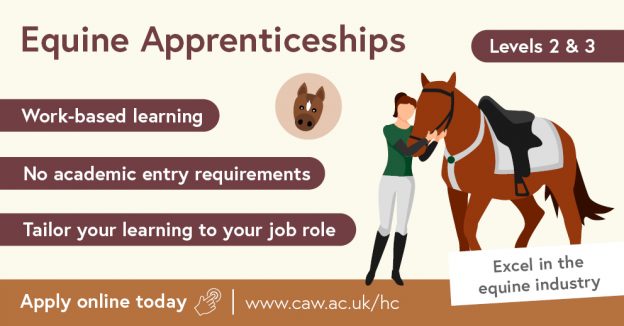
Excel in the horse care industry with an equine apprenticeship

Whether you’re looking to begin an exciting career in horse care, or have been working in the equine industry for some time, our equine apprenticeships can help you reach your career goals: 

Suitable for those who are new to the equine industry. Undertaking this apprenticeship will allow you to earn whilst you learn, developing your practical skills and knowledge.

Ideal if you’re working in the equine industry in a position of responsibility, such as head groom, and are looking for a more advanced level of study to reflect your experience and knowledge.

Quick Facts

  • 12-24 months depending on level
  • Start at any time
  • Available in England
  • No college attendance
  • Work-based learning assessor support
  • Suitable employment in an equine environment required
  • Tailor the programmes to your specific job role and interests by choosing a pathway: Breeding, Driving, Racing, Riding, Non-riding

Download the Equine Apprenticeships Infographic

Content and Entry Requirements

Our equine apprenticeships are suitable for those living and working in England in a suitable equine environment (such as a riding school, racing yard or horse charity), earning at least the National Minimum Wage for Apprentices. During the programmes you will gain industry recognised skills and knowledge such as:

  • Safe Working Practices
  • Yard and Field Routines and Duties
  • Horse Anatomy, Physiology and Welfare
  • Horse Handling, Care and Appearance
  • Saddlery and Equipment
  • Travelling Horses
  • Non-Ridden Exercise
How to Find an Equine Apprenticeship

How to Find an Apprenticeship Working with Horses

If you’re interested in undertaking an equine apprenticeship with us, you need to be living and working in England in a suitable equine environment (such as a riding school, horse charity or racing yard), within a 90 minute radius of our Huntingdon centre.

Working in the equine industry is a popular choice for many, meaning that equine apprenticeships can sometimes be hard to come by. If you’re struggling to find the role needed to apply for one of our equine apprenticeships, don’t give up on your ambitions. Check out our tips and advice about how you can find an equine apprenticeship position here:

Search for equine apprenticeships on the government’s “Find an apprenticeship” website

Many training providers post their apprenticeship vacancies on the government’s  “Find an Apprenticeship” website at: https://www.findapprenticeship.service.gov.uk

On this website you can search by location or keywords to find your ideal vacancy. Once you have found an apprenticeship that interests you, create an account via the website to apply!

Check local newspapers and online jobs boards

Online job boards such as Indeed often list recent equine apprenticeship positions. 

Follow local equine colleges and equine employers on social media

Many training providers and equine employers such as stables or racing yards may post their latest apprenticeship vacancies on their social media pages, so it’s worth following those pages to ensure you are the first to see any new opportunities. Follow The College of Animal Welfare on Facebook

Contact equine employers directly

By contacting employers to introduce yourself and enquire about equine apprenticeships directly, you are putting a face to your name and showing commitment and enthusiasm!

You can drop them an email, give them a call or even stop by the practice to meet staff members in person. Even if they are unable to offer you an apprenticeship at that moment, they may be able to hold your details ready for future opportunities, or introduce you to other members of the profession who can help you gain a placement.

You could contact stables, riding schools, racing yards or equine charities. If you would like to check your employment makes you eligible for the course prior to applying, please contact us.

Attend relevant open evenings and career days

Career days such as our Careers With Animals Day bring local employers and colleges under one roof, which is the perfect opportunity to discuss your career plans and gain advice from industry professionals. What’s more – they can be a good opportunity to meet with employers directly to discuss equine apprenticeship opportunities.

Ensure your CV is up-to-date

Keeping your CV up-to-date means you’ll be able to apply for equine apprenticeship positions as soon as they become available. Make sure your CV contains any relevant experience or hobbies that you may have that will complement your application, for example any additional horse care studies or work experience in an equine environment such as a stables or riding school.

If you find an apprenticeship position that is outside of a 90 minute radius of our Huntingdon centre, please contact us as we may still be able to meet your training needs.

Our Equine Apprenticeships at a glance…

Useful sources to get started

Veterinary Nursing – City and Guilds FAQs

Following City & Guilds’ decision to withdraw veterinary nursing from its portfolio of qualifications*, we have issued a statement and answered a number of questions you may have about what this means for veterinary nurse training: 

Does this decision by City and Guilds (C&G) mean that training for Veterinary Nursing will be stopped?

No, it will continue as before but instead of there being three awarding organisations offering a veterinary nursing qualification, there are now two.

I have just started my new veterinary nursing course at the College of Animal Welfare how does this news affect me?

All College students who started their training after 31st December 2019 are registered with Vet Skill and so this announcement makes no difference to you.

I have just finished my City and Guilds Level 3 Diploma in Veterinary Nursing and am waiting for my certificate.  Will I still receive it?

Yes, you will.  Well done on your achievement.

If I pass my C&G qualification will I still be able to register with the RCVS?

Yes any person holding a valid qualification certificate for the C&G Level 3 Diploma in Veterinary Nursing may apply to the RCVS for Registration as a Veterinary Nurse. 

What happens if a student who is registered with C&G does not complete their qualification by the 31st August 2023?

Assuming that all our students progress as expected this should not happen because the course timetable has sufficient time before this date for you to qualify.  However, going forward the College will closely monitor each students progress to identify as quickly as possible any student who becomes at risk of this happening to.  If concerns are raised these will be discussed with individual students and their employers and a way forward determined on a case by case basis. 

I am not studying veterinary nursing at CAW.  Can you advise me on what I should do?

We are always here to help anyone as best we can but if you have any concerns you should contact your own College who will know your circumstances and will be able to best guide you.  Failing that we would recommend that you contact the RCVS for advice.

My practice is a TP with CAW how does this decision by C&G affect my status as a TP?

It does not make any difference to your TP status.

I am an Apprentice undertaking the Apprentice Standard in Veterinary Nursing.  When will I be able to complete my End Point Assessment?

It is expected that the first end point assessments will become available this Summer. 

I am a C&G SVN training at CAW will I be charged extra?

There are no extra fees involved in completing your existing course as a result of this decision by C&G.

I am a CAW TP with C&G students at CAW will I incur any extra costs as a result of this decision?

There are no extra fees involved in current C&G students completing their existing programmes.  Fees do vary between Awarding Organisations but when we moved to Vet Skill in January Vet Skills fees were made known but obviously do not relate to C&G’s decision.

View The College of Animal Welfare’s statement here.

Follow us on social media to be the first to see any new updates and information about our veterinary nurse training: 

[ss_social_follow networks=”facebook;twitter;instagram;pinterest”]

Veterinary Nursing – City and Guilds Update

Following City and Guilds (C&G) announcement of their intention to no longer offer their Level 3 Veterinary Nursing qualification The College of Animal Welfare (CAW) would like to provide reassurance to employers and students.

From the 1st January 2020 we made the decision to move to the VetSkill Level 3 Diploma in Veterinary Nursing for all of our new students. This decision was based on a number of factors which are beneficial to the development of student veterinary nurses and support their progression through to qualification and registration.

College students who have started their Veterinary Nursing programme prior to this date will have the opportunity to complete their programme with C&G in accordance with their scheduled programme prior to the C&G final certification claim deadline of the 31st August 2023.   There will be sufficient time for students to undertake a number of attempts of their OSCE’s should this prove necessary.   However, should a student experience a change in their personal circumstances (e.g. long term illness) during their programme then a different approach may prove necessary.

C&G have also announced that they will not be applying to become an End Point Assessment Organisation (EPAO) for Veterinary Nursing. 

Central Qualifications (CQ) have already been approved as an EPAO for Veterinary Nursing and are expected to make available their service in the summer, possibly sooner.  We understand that Vet Skill have applied to become an EPAO for veterinary nursing and that their application is in process and if approved their EPA is expected to become available likewise in the summer.  The College is therefore confident that employers with students undertaking the Apprenticeship Standard in Veterinary Nursing will be able to arrange for their students to undertake their EPA and complete their Apprenticeship later this year.

As this situation develops the College will be advising apprentices and employers regarding the options available and how the VN Apprenticeship Standard can be completed. 

The College has also provided a list of frequently asked questions that is available on our website.

Finally, The College of Animal Welfare would like to acknowledge its appreciation to City and Guilds for their support of the Veterinary Nursing profession and the thousands of veterinary nurses that they have assisted in achieving their personal aspirations to have a meaningful and valued career in the veterinary profession.

For more information please call The College of Animal Welfare on 01480 422 060 or email admin@caw.ac.uk

Book Clinical Coach Congress 2020 at early bird rates before it’s too late!

The deadline to book onto Clinical Coach Congress 2020 with an early bird discount is fast approaching (31 January 2020).

This year’s event, sponsored by Millpledge Veterinary, is returning to the wonderful East of England Arena and Events Centre in Peterborough, and will include lectures on exam techniques, common OSCE mistakes, building strong coach and student relationships, time management and much more. Delegates will also be able to speak to a variety of exhibitors from across the veterinary profession.

As a standardisation event recognised by the Royal College of Veterinary Surgeons (RCVS), Clinical Coach Congress is an ideal opportunity to network with fellow clinical coaches and full attendance achieves 12 hours of CPD.

Clinical Coach Congress is held on Monday 16 and Tuesday 17 March, and delegates have until January 31st 2020 to secure their place at the early bird rate of £249.00 + VAT for both days. To book and see the complete agenda visit our website or call us on 01480 422060.

Clinical coach benefits

Becoming a Clinical Coach FAQs

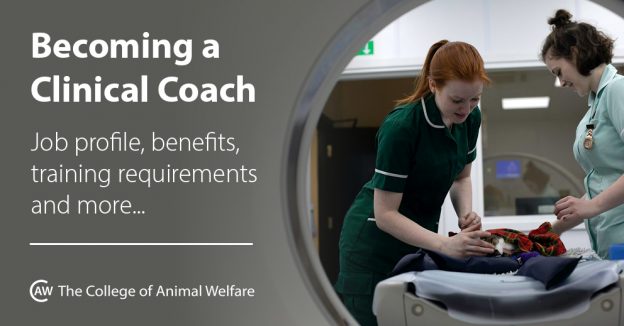
Beside every great veterinary nurse is a great clinical coach, who supported them through their formal training and helped them develop their practical skills in practice.

If you’re passionate about veterinary nursing and keen to help others flourish in the industry, you may have considered becoming a clinical coach before and asked yourself: what are the benefits of taking on the role?

To answer that question, read more about what clinical coaches do, what you can get out of it and the training process…

What do clinical coaches do?

The main role of the clinical coach is to support an SVN in practice and provide opportunities to ensure they complete their Nursing Progress Log (NPL) or e-portfolio. The role can be summarised as follows:

Clinical Coach Job Description

Provide support and opportunities for an SVN to complete the NPL or online e-portfolio


  • Ensure personal practical skills are maintained to support the SVN
  • Make time to spend with the SVN on their practical skills
  • Ensure there is opportunity for the SVN to complete NPL/e-portfolio tasks in the rota
  • Ensure the SVN has a clear plan for their time at the practice
  • Provide opportunities for the SVN to ask questions / reflect on progress


Making the SVN a part of the team

  • Become the SVNs personal cheerleader
  • Make sure the SVN feels included in the team
  • Ensure the SVN’s training needs are reflected in team plans


Why Become a Clinical Coach?

There are a number of benefits to becoming a clinical coach.

  1. It isn’t just the student who is learning: There’s nothing like a student questioning everyday routines in practice, to help you review and improve your own clinical skills. What’s more – you can also use the student’s access to the most up-to-date academic materials to help you improve patient care across the team.
  2. Become a coaching and mentoring guru: Clinical coaching is a great avenue for Continuing Professional Development (CPD), a move from a clinical focus to coaching and mentoring skills, which may pave the way to formal qualifications.
  3. Be a cheerleader for your practice: Becoming part of a team who trains students will help contribute to good practice reputation. 81% of consumers favour employers who hire apprentices, and clients understand that training means there is supervision and this is good for patient care.
  4. Mastering reflection and organisation: As a clinical coach, you need to be organised, be able to plan your student’s time effectively and reflect upon your student’s progress so you can provide helpful support. Supervising students will help you improve your reflection and organisational skills.
  5. The feel good factor: It’s rewarding to be able to use your skills and expertise to help the next generation of nurses achieve career success.

“It is incredibly rewarding seeing new students return from college with a renewed interest in their work and I guarantee your staff will be more enthusiastic and committed once they have a goal in sight.” Read Wendy Taylor’s blog about the benefits of training student veterinary nurses

I want to become a clinical coach. What do I do next?

In order to train veterinary nurses, veterinary practices have to first be approved as either a Training and Assessment Practice (TP) or an Auxiliary Training Practice (aTP,) by an Approved Centre (Primary Centre). If your practice is not an approved TP or aTP, read more about the approval process.

If your practice is an approved TP or aTP, in order to become a clinical coach you will need to attend a one day training course which will cover the use of the NPL as well as lots of best practice information and tips on coaching/mentoring your student. You will then be required to attend a standardisation event every 12 months to maintain your currency. Both of these courses are free to our TPs or to clinical coaches who support our students.

Clinical coaches must provide evidence of clinical coach training and a copy of their CV and job description, to show their clinical experience. Evidence of Continuing Professional Development (CPD) will also be requested at regular intervals by the practice’s Quality Assurance Supervisor.

If you would like to become a Clinical Coach, please contact us for more information.

I am a clinical coach and want to develop my role. What can I do? 

We run an annual Clinical Coach Congress, which is the largest event of its kind, dedicated exclusively to supporting clinical coaches that are training student veterinary nurses in practice.

During the congress you will be able to listen to a jam packed timetable of relevant talks, as well as gain lots of best practice information and tips on coaching/mentoring students. Not only this, but attending both days of congress achieves 12 hours of CPD! 

Clinical Coach Congress may be particularly useful if you’re new to the role of a clinical coach and looking for some guidance, or if you’re more experienced and looking to develop your role further and discuss ideas with fellow clinical coaches. 

Book your place today