Author Archives: Amber Tennant

animal care traineeship advertisement

There’s still time to apply for our animal care traineeship!

If you’re aged 16-24, unemployed and looking for experience working with animals, there’s still time to apply for our animal care traineeship programme starting this July!

The 12 week programme will run from our centre in Tingley (near Leeds), and will give you the opportunity to…

  • Work in a kennels/cattery, dog grooming parlour and reception area in a busy animal care environment.
  • Develop employability skills including CV writing and interview techniques
  • Receive support with job applications and Maths/English skills
  • Receive tuition to help you work towards a Level 1 Award in Work-based Animal Care

To apply for a place on the CAW Traineeship Programme, you must be unemployed with little or no work experience and meet the following criteria:

  • Aged 16-24 on 31 August 2018
  • All applicants must have lived in the UK for the last 3 years and be ordinarily resident in the UK

The course begins on Tuesday 23 July, with interviews taking place on Monday 1 July. For more details about the programme and how to apply visit our website.


The BVNA Council election 2019 is now open!

The BVNA Council election 2019 is now open!

The election will ask members to decide who will represent them on their Council.

The field of nine candidates represent a wide range of interests, ideas and priorities. Members can view the profiles of each candidate on the BVNA website, which covers more about the person, what is important to them, and what they would like to do if elected on to Council.

Polls close at noon on Friday 12 July. Each member can vote for up to three candidates. For more information on the election and timetable please visit the BVNA website.

Click here to vote in the BVNA Council Election 2019

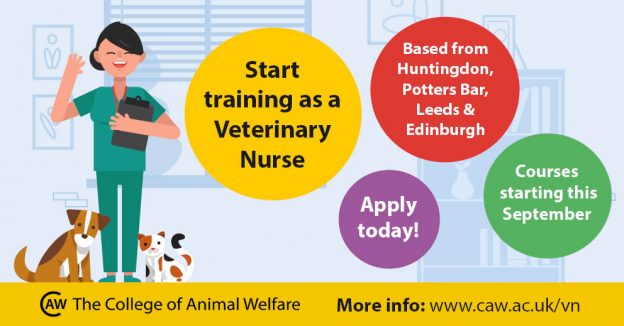
veterinary nurse training advertisement

Start training as a veterinary nurse this September!

Veterinary nurses care for our pets and make a real difference to the lives of animals every single day – and you could be the next to join them!

Applications for our Level 3 Diploma in Veterinary Nursing programmes starting this September are open now…

Throughout the course you will develop the key skills and knowledge needed to thrive as a veterinary nurse, as well as gain significant industry experience in a veterinary practice, either as a paid employee or a non-employed student on work placement. Courses are available on a day release basis at our Huntingdon, Potters Bar and Leeds centres, or on a block release basis at our Edinburgh centre.

Find out more about the course and apply to start training as a veterinary nurse this September!

Is veterinary nursing for you?

Veterinary nursing is the perfect job if you’re looking for a challenging and rewarding career working with animals. Every day will offer variety and you could be involved in anything from helping a veterinary surgeon in theatre to advising an owner on pet welfare. Find out more about the role of the veterinary nurse 

Where can a VN qualification take you?

Veterinary nursing is a varied, rewarding career path that has a wide range of professional opportunities. If you’re considering training as a veterinary nurse in the future – find out more about the career opportunities available to a veterinary nurse!


Veterinary nursing career information

Veterinary Nursing Awareness Month: Is Veterinary Nursing the career for you?

If you’re interested in kick-starting a career as a veterinary nurse, read on to find out more about the role and how you can get qualified…

The role

Veterinary nurses use their technical knowledge and hands on expertise to care for our pets with skill and empathy; it’s the perfect job for those looking for a varied, challenging and rewarding career where you will make a difference to the lives of animals every single day.

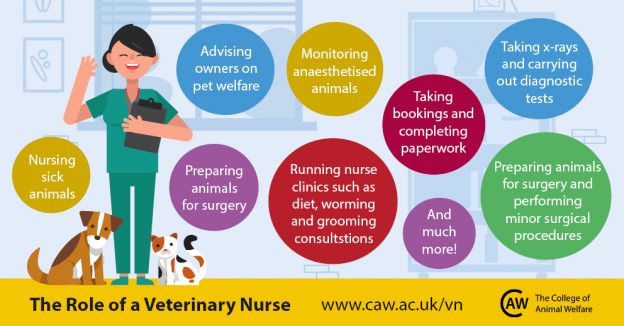
In any given day you will find yourself involved in a variety of different tasks, from helping a veterinary surgeon in theatre to advising an owner on the most appropriate method of flea control for their pet. Your regular work may include:

  • Preparing animals for surgery and performing minor surgical procedures
  • Monitoring anaesthetised animals
  • Nursing sick animals and administering medication
  • Taking x-rays and carrying out diagnostic tests
  • Advising owners on the health and welfare of their pets
  • Taking bookings, payments and completing necessary paperwork
  • Running nurse clinics, such as diet, worming and grooming consultations

Is the role for you?

Good veterinary nurses are passionate about and dedicated to caring for animals. Often veterinary nurses end up taking their work home with them – sometimes quite literally in the form of kittens that need hand rearing or abandoned or stray animals!

You must enjoy working as part of a close knit team but also have the confidence to work with little supervision and be able to cope with the emotional and physical demands of the job. Inevitably, there will always be kennels and cages to clean, and floors to mop, so you also need to be prepared for hard and dirty work sometimes.

Want to start training as a veterinary nurse?

If you’re looking to kick-start a career as a veterinary nurse, we run diploma courses from our centres in Huntingdon, North London, Leeds and Wigan starting in September, January and April. A block release course is available in Edinburgh starting in September.

As a day release student you would attend college one day per week alongside employment in a veterinary practice. If you want to train as a veterinary nurse but perhaps don’t have the qualifications or finances to study at university, or would prefer to find employment in a practice and earn a living whilst studying at the same time, then this could be the course for you.

You can apply to start training as a veterinary nurse today! More information about the course can be found on our website.

Veterinary Nursing Awareness Month (VNAM) was originally started by BVNA in 2005 as National VN Day and has since progressed into National VN Week, followed by a whole month campaign since 2012 to spread the word about the importance of the role of the veterinary nurse in practice and the provision of responsible pet care to the general public. To find out more visit the BVNA website.

Follow us on social media to be the first to see our latest veterinary nursing careers advice and resources: [ss_social_follow networks=”facebook;twitter;instagram;pinterest”]


dog and cat - animal care traineeship featured image

New animal care traineeship starting this July!

If you’re aged 16-24, unemployed and looking for experience working with animals, an animal care traineeship could be just what you need to kick-start your career…

Our new animal care traineeship programme is starting this July!

The 12 week programme will run from our centre in Tingley (near Leeds), and will give you the opportunity to…

  • Work in a kennels/cattery, dog grooming parlour and reception area in a busy animal care environment.
  • Develop employability skills including CV writing, interview techniques
  • Receive support with job applications and Maths/English skills
  • Receive tuition to help you work towards a Level 1 Award in Work-based Animal Care

To apply for a place on the CAW Traineeship Programme, you must be unemployed with little or no work experience and meet the following criteria:

  • Aged 16-24 on 31 August 2018
  • All applicants must have lived in the UK for the last 3 years and be ordinarily resident in the UK

The course begins on Tuesday 23 July, with interviews taking place on Monday 1 July. For more details about the programme and how to apply visit our website.

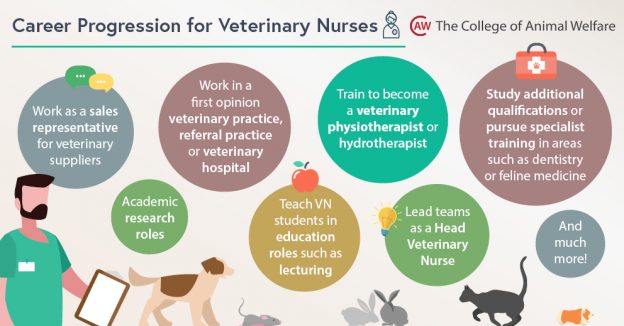
Career Progression for Veterinary Nurses

Where can an RVN qualification take you?

Where can an RVN qualification take you?

Veterinary nursing is a varied and rewarding career path which opens up a wide variety of professional opportunities. Whether you’ve just qualified as a veterinary nurse, have been working in the industry for some time and looking for a career change, or considering training as a veterinary nurse in the future – read on to find out more about veterinary nursing career opportunities…

General practice

Jobs in veterinary practice on completion of formal training are excellent. Many veterinary nurses choose to remain in first opinion veterinary practice, however there are also options to move into referral practice or into a large veterinary hospital and specialize in a particular area, such as surgical nursing. You could also become a locum veterinary nurse.

Nurses must continue to study and log professional development hours to maintain their registration throughout their careers. This means there is plenty of opportunity to pursue professional interests, study additional qualifications such as the RCVS Diploma in Advanced Veterinary Nursing, or undertake specialist training in a range of topics, particularly the care of exotic pets, feline medicine, anaesthesia and dentistry.

Education

Many RVNs use their qualifications to pass on skills and expertise to the next generation of nurses in education roles. Teaching positions can vary widely, but veterinary nurses who choose to take up a role in education might be writing and developing course content, presenting lectures, workshops and practical teaching sessions, providing student support and guidance, assessing and moderating students, or undertaking research and representing educational institutions at conferences and exhibitions. Find out more about becoming a Veterinary Nursing Lecturer

Leadership and Management

If you’re looking for leadership and management opportunities within veterinary practice, you could become a head nurse.

Head Veterinary Nurses lead and provide support to veterinary nursing and veterinary care teams in practice. Day-to-day, this may cover many areas in team management, for example recruitment, selection, development, absence reporting and monitoring in line with practice policies. The role is perfect if you’re looking for a bigger influence over practice life by developing staff and clinical practice. You could even work towards becoming a veterinary practice manager over time. The Veterinary Management Group (VMG) can provide more information about management opportunities and training.

Sales

Another career route you may take once you have qualified as a veterinary nurse is working for one of the many companies and service providers that supply the veterinary industry as a sales representative.

Becoming a veterinary sales representative is one of the less-recognised career paths open to veterinary nurses. It offers a fantastic opportunity to travel, meet new people and help veterinary surgeons, veterinary nurses and other professionals to deliver better care to their patients.

As a veterinary sales representative you would be promoting new products directly to people involved in animal health. You would keep your clients up-to-date with fresh developments and recent scientific advances. You may also offer in-house, product-related training for clients.

Rehabilitation

As a qualified veterinary nurse, you could grow your career by training to become a veterinary physiotherapist or hydrotherapist. Rehabilitation following veterinary referral can help animals recover following surgery and from a variety of conditions such as pack pain, sprains, strains, fractures and sporting injuries. It has become a growing service within specialist veterinary hospitals, referral centres and first opinion practices. You can visit our career profiles to find out more about how to pursue a career in veterinary rehabilitation.

Writing and research

If you have studied to become a veterinary nurse at degree level, you may wish to pursue a career in conducting and publishing research. This work is essential to developing veterinary nursing techniques and championing evidence-based practice.

You could also take your academic development in a new direction by speaking at industry congresses and events. If you have a creative flair, you could also aim to become a freelance writer. You could even start your own blog!

Want to train as a veterinary nurse?

Career opportunities for qualified veterinary nurses are varied and wide-ranging.

If you’re looking to kick-start a career as a veterinary nurse, we run diploma courses from our centres in Huntingdon, North London, Leeds and Wigan starting in September, January and April. A block release course is available in Edinburgh starting in September.

As a day release student you would attend college one day per week alongside employment in a veterinary practice. If you want to train as a veterinary nurse but perhaps don’t have the qualifications or finances to study at university, or would prefer to find employment in a practice and earn a living whilst studying at the same time, then this could be the course for you.

Apply to start training as a veterinary nurse

Veterinary Nursing Awareness Month (VNAM) was originally started by BVNA in 2005 as National VN Day and has since progressed into National VN Week, followed by a whole month campaign since 2012 to spread the word about the importance of the role of the veterinary nurse in practice and the provision of responsible pet care to the general public. To find out more visit the BVNA website.
 

CAW Connect: A new alumni association!

We are delighted to announce the launch of our new and exclusive alumni association, CAW Connect!

CAW Connect is a new social networking website and education hub which will give our alumni the opportunity to:

  • Be part of a professional online community: As an alumni member you will become a part of a close knit network of industry professionals, where you can connect with your classmates and network with other alumni!
  • Access special alumni discounts and CPD offers: We have put together a wealth of industry benefits especially for our alumni. Gain discounts on industry congresses, CPD courses, professional body membership, clothing, merchandise – and much more! What’s more – members will also see the beginning of special alumni events and competitions. Watch this space…
  • Benefit from exclusive resources and careers advice: Get ahead in the industry with the help of free careers advice, newsletters and resources from the college, all exclusive to our alumni community!
  • Contribute to an online education hub: CAW Connect is the perfect place to enhance animal welfare by sharing knowledge, news and best practice with your new connections; and keep up-to-date with the latest industry news, views and developments using group forums and blogs!
  • Stay up-to-date with college fundraising: As an alumni member, you can have your say on which charities the college supports, and team up with fellow alumni members to fundraise and make a real difference in your community!

CAW Connect will be open to students who have completed an accredited course with us at the point of certification. If you have a completed a course with us in the last 7 years, you will receive your login details shortly. If you completed a course before this, please visit our website to request your login details.  To find out more about our alumni association visit www.caw.ac.uk/alumni

Veterinary care support apprenticeship pathway blog image

Is a veterinary care support role for you?

Whether you’re just out of school and looking to kick-start a career with animals, have always wanted to work with animals and looking for a career change, or unemployed and looking to get back into the industry, veterinary care could be the perfect career for you!

Why train in veterinary care?

Veterinary Care Support staff are crucial members of today’s modern veterinary team, working alongside veterinary surgeons and veterinary nurses to provide vital nursing care to small animal patients. The role is varied and every day you will be involved with:

  • Exercising, grooming and feeding hospitalised animals (inpatients)
  • Monitoring and providing supportive care to inpatients
  • Preparing theatre and relevant equipment
  • Cleaning and preparing accommodation for animals
  • Restraining animals for treatment
  • Reception duties, including advising clients on preventative health care e.g. flea treatment
  • Record keeping

Although hours can be long and the work physically and emotionally demanding, the rewards that come from being part of a team that work together to nurse animals back to health, make the job extremely worthwhile and fulfilling!

What’s more – career progression is excellent!

Many VCAs go on to complete additional qualifications such as the Level 2 Certificate in Assisting Veterinary Surgeons in the Monitoring of Animal Patients programme, or even go onto train as a veterinary nurse by undertaking the Level 3 Diploma in Veterinary Nursing, as an apprenticeship or standalone qualification.

Start your training today on our NEW Veterinary Care Support Apprenticeship programme!

If you’re set on training to become a veterinary care support professional, we are delighted to announce we now offer a *NEW* Veterinary Care Support (VCS) apprenticeship programme!

This apprenticeship will provide a tailored learning experience allowing you to develop the skills, knowledge and experience needed to thrive as a VCA by undertaking on-the-job training in a veterinary practice. You will learn skills such as:

  • common medical, behavioural and surgical care requirements
  • the principles of care and related procedures and how to deal with these
  • clinical parameters of common species seen in a veterinary environment
  • legislation and limitations in relation to role and responsibilities in a clinical environment
  • legislation in relation to the dispensing and administering of medication
  • end of life care processes, procedures and support
  • how to deal with emotional customers/clients
  • exercise/socialise animals and provide appropriate enrichment relevant to their specific needs
  • provide food and water to animals and monitor intake
  • maintain, update and reference correct records in accordance with current legislation

The new apprenticeship is available now. To find out more about the new programme visit our website or call us on 01480 422060!


LEP Apprenticeship Grant for Employers

There is no better time for a business to take on their first apprentice. From 1 April 2019 the training costs of an apprenticeship to a business has dropped by 50%. This means the government will pay 95% of the cost of the apprenticeship, leaving just 5% payable by the employer!

What’s more…

Grants of up to £2,500 are available for small businesses (249 or fewer employees) to recruit an apprentice.

If you’re based in Bradford, Calderdale, Kirklees, Leeds, Wakefield or York you can apply for the apprenticeship grant for employers (AGE) from Leeds City Region Enterprise Partnership (LEP).

Am I eligible to apply?

  • A core grant of £2,000 is on offer, allocated on a first-come, first served basis and you’ll need to meet the full grant eligibility criteria
  • Businesses with 249or fewer employees within local authority areas of Bradford, Calderdale, Kirklees, Leeds, Wakefield and York
  • Have never offered apprenticeships before
  • Are offering new employment as an apprenticeship opportunity to 19-24 year olds with associated apprenticeship training via a training provider approved by the Education Skills Funding Agency (ESFA)
  • The Apprentices must be following a recognised Apprenticeship Standard or Framework
  • Are paying the national minimum wage for the age of the apprentice from day 1 of their apprenticeship training (above the apprenticeship wage of £3.90).  This equates to £6.15 per hour for 18-20 year olds, £7.70 per hour for 21 – 24 year olds.

An additional top up grant of £500 is on offer if:

Find out more on the Leeds City Region Enterprise Partnership (LEP) website

Apply for the LEP AGE grant

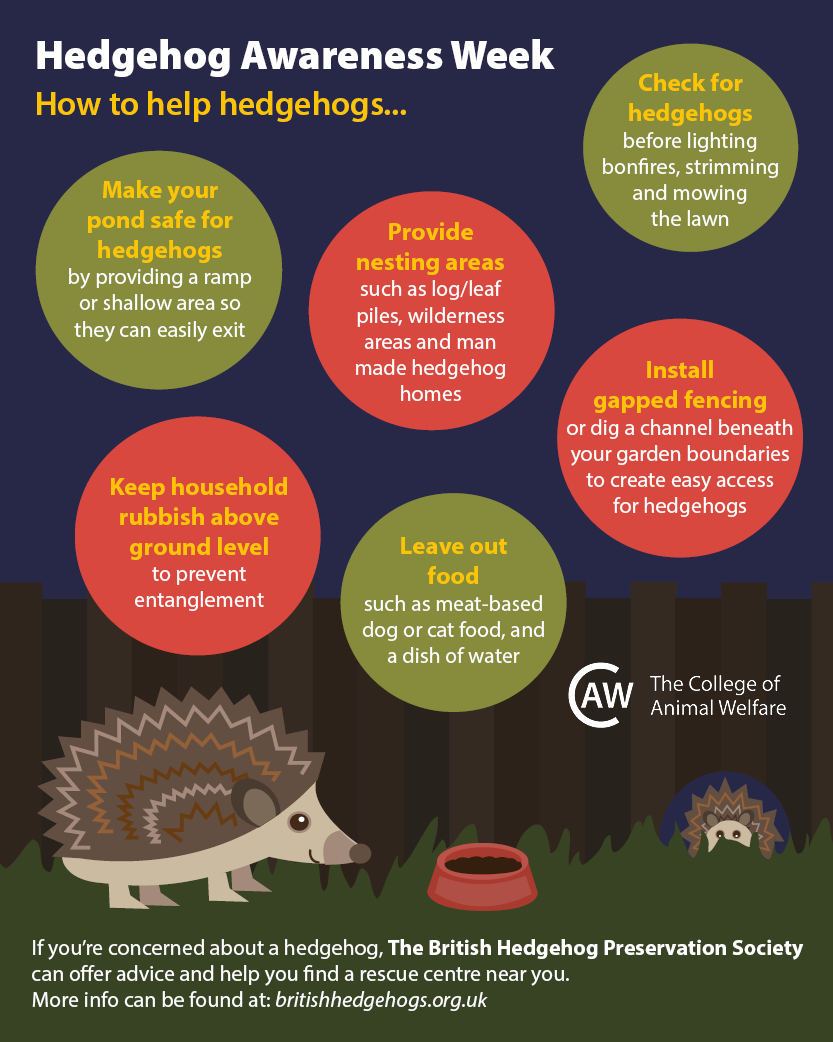
Hedgehog Awareness Week Infographic Full Size

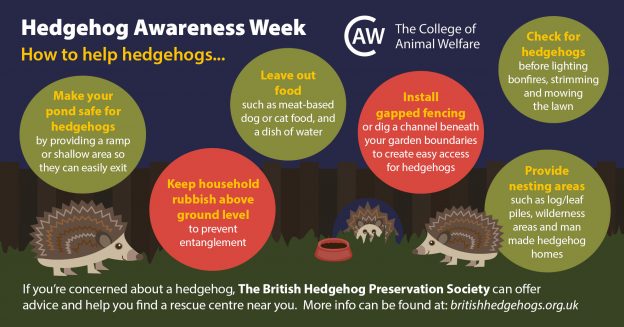
Hedgehog Awareness Week 2021: How to help hedgehogs

It’s Hedgehog Awareness Week 2021!

Hedgehog numbers have fallen by 30 percent in just over 10 years, and there are now thought to be fewer than 1 million left in the UK. You can help this threatened species to thrive by making small changes in your garden, such as:

  • Making your pond safe for hedgehogs by providing a ramp or shallow area so they can easily exit
  • Providing nesting sites such as log/leaf piles, wilderness areas and man made hedgehog homes
  • Checking for hedgehogs before lighting bonfires, strimming and mowing the lawn
  • Installing gapped fencing or dig a channel beneath your garden boundaries to create easy access for hedgehogs
  • Leaving out food such as meat-based dog or cat food and a dish of water
  • Keeping household rubbish above ground level to prevent entanglement

If you’re concerned about a hedgehog, The British Hedgehog Preservation Society can offer advice and help you find a rescue centre near you. To find out more visit the BHPS website.

If you would like to find out more about how you can get involved in saving this threatened species, The ‘Hedgehog Street’  is a joint campaign by the People’s Trust for Endangered Species (PTES) and the British Hedgehog Preservation Society (BHPS), which provides useful information, suggests activities and sends out regular bulletins. More information can be found on the Hedgehog Street website.

Hedgehog awareness week infographic - how to help hedgehogs3