Author Archives: Amber Tennant

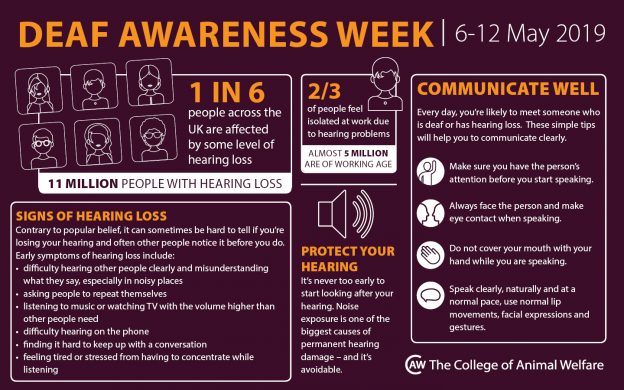
Deaf Awareness Week 2019

This year’s Deaf Awareness Week is here!

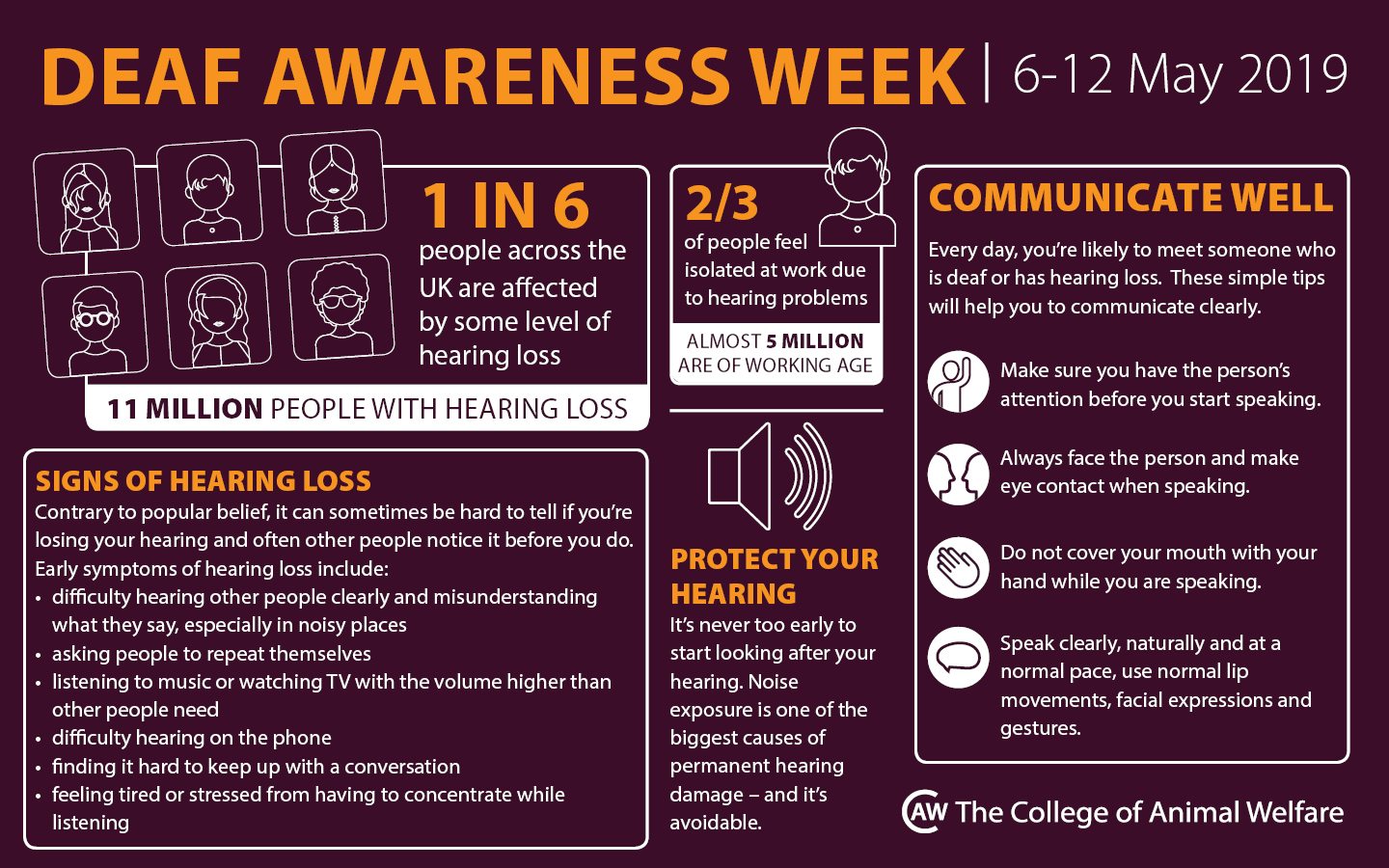
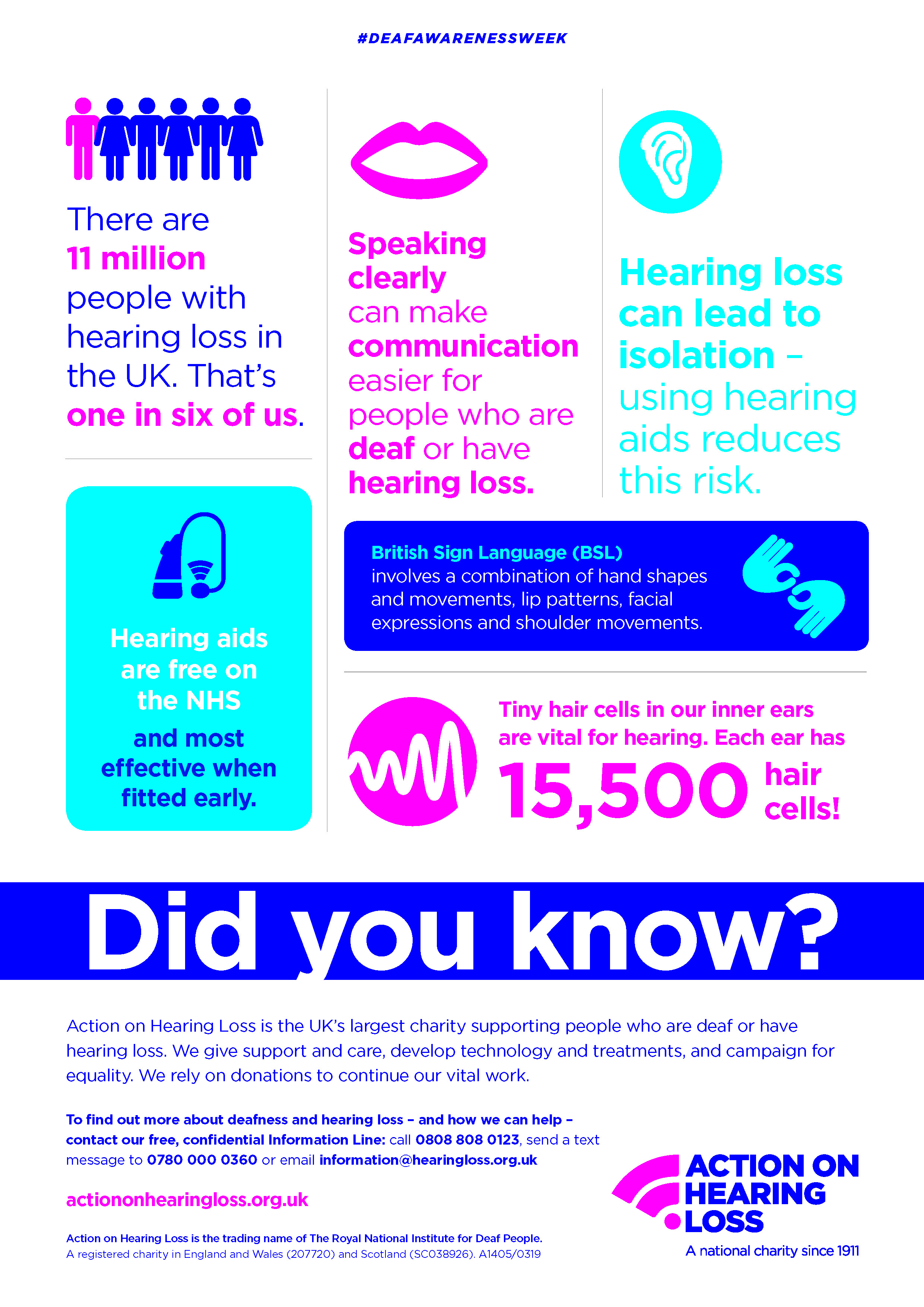
There are around 11 million people with hearing loss in the UK, with an estimated 900,000 people with severe or profound hearing loss.*

This week is the perfect opportunity to raise awareness of hearing loss and deafness across the UK, how to help people living with hearing loss, and encourage those who have noticed the first signs of hearing loss to seek help.

Signs of hearing loss

Contrary to popular belief, it can sometimes be hard to tell if you’re losing your hearing and often other people notice it before you do. Early symptoms of hearing loss include:

  • difficulty hearing other people clearly and misunderstanding what they say, especially in noisy places
  • asking people to repeat themselves
  • listening to music or watching TV with the volume higher than other people need
  • difficulty hearing on the phone
  • finding it hard to keep up with a conversation
  • feeling tired or stressed from having to concentrate while listening

If you notice any problems with your hearing, read more about treatments for hearing loss and make sure you book an appointment with your GP so you can find out the cause and gain advice on the most appropriate treatment.

How you can help

Hearing loss can lead to withdrawal from social situations, emotional distress, and depression. Research also shows that it can increase the risk of loneliness and dementia.* You can help by:

  • Spreading understanding about hearing loss and deafness
  • Learning and using British Sign Language (BSL)
  • Donating to, volunteering or fundraising for charities which provide information, advice and support to people who live with deafness or hearing loss, such as Action on Hearing Loss
  • Donating to, volunteering or fundraising for charities which train hearing dogs to support deaf people, such as Hearing Dogs for Deaf People
  • Practicing good communication skills such as maintaining eye contact, speaking clearly and at a normal pace and keeping your mouth uncovered to facilitate lip-reading

A1405_DAW19_Did-you-know


Train to become a dog groomer on a Saturday at The College of Animal Welfare!

If you’re tired of your 9-5 job and want a career that you’re passionate about, training to become a dog groomer could be your next career move!

City & Guilds accredited dog grooming courses run at the College give learners the experience and knowledge needed to secure long-term career prospects within the dog grooming industry. What’s more…

From June 2019 we will be running our City & Guilds Level 2 Certificate for Dog Grooming Assistants course on a Saturday for the very first time, meaning getting qualified around a busy schedule is easier than ever before!

Learners undertaking this course will train with guidance from qualified dog groomers in our state-of-the-art grooming suites in Huntingdon or Leeds. Further information on the Saturday day release courses starting in June 2019 can be found at www.caw.ac.uk/dg or by calling us on 01480 422060.

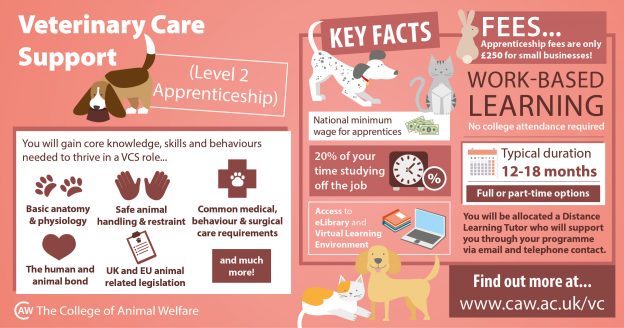
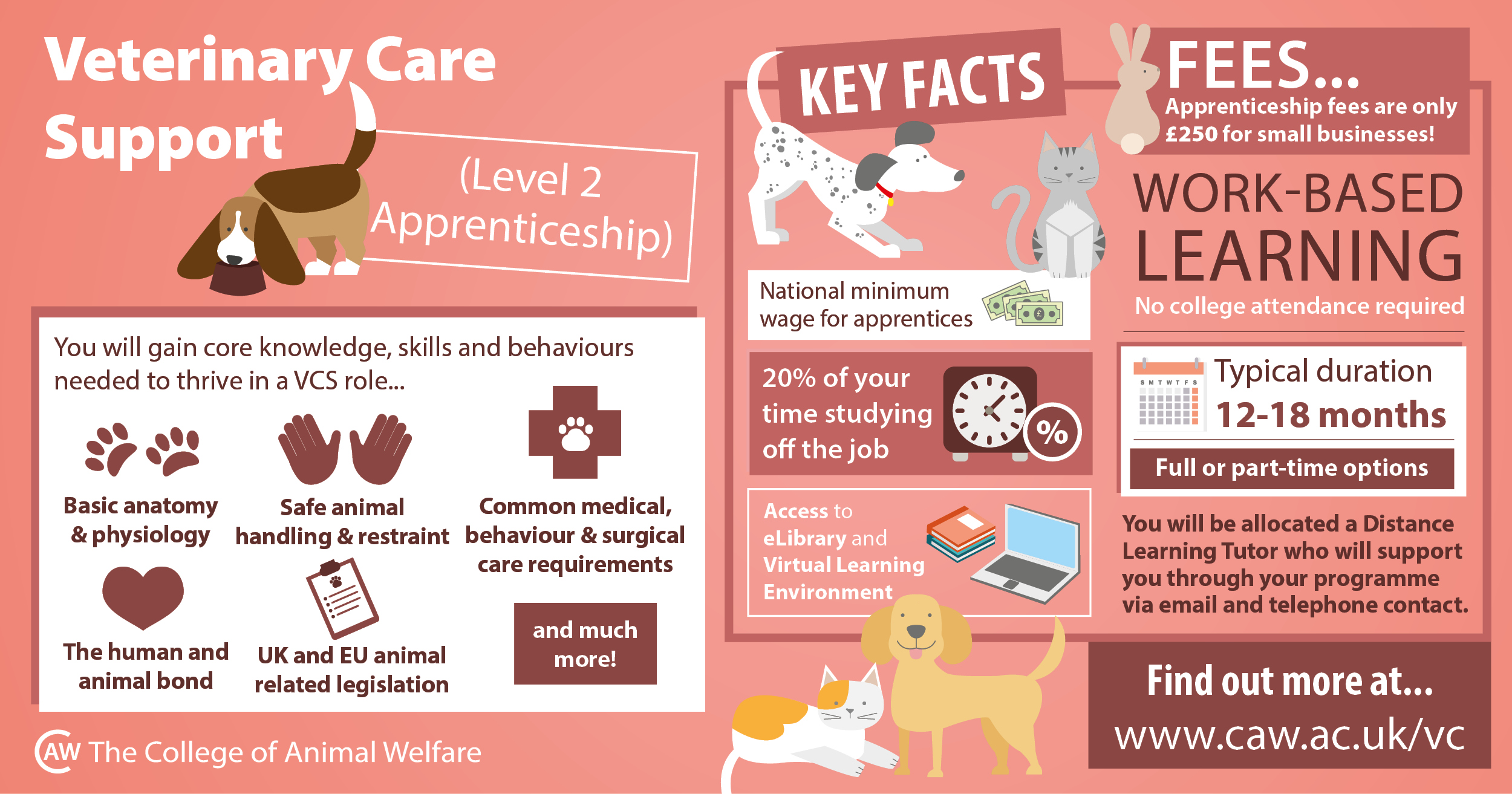
veterinary care support apprenticeship infographic

Veterinary Care Support Level 2 Apprenticeship: By employers, for employers

We recently launched a new Veterinary Care Support (VCS) apprenticeship pathway, designed to provide a tailored learning experience for those who currently work in a VCS role with little to no formal training, as well as a route into employment for people who want to work in a VCS role in the future!

Read on to see what this means for apprentices and employers alike…

Current, tailored learning for VCS apprentices

The new pathway has been developed by employers, for employers. As such, apprentices undertaking the veterinary care support (VCS) pathway will learn the skills, knowledge and experience needed to thrive as a VCA by undertaking on-the-job training in a veterinary practice. They will learn skills such as:

  • common medical, behavioural and surgical care requirements
  • the principles of care and related procedures and how to deal with these
  • clinical parameters of common species seen in a veterinary environment
  • legislation and limitations in relation to role and responsibilities in a clinical environment
  • legislation in relation to the dispensing and administering of medication
  • end of life care processes, procedures and support
  • how to deal with emotional customers/clients
  • exercise/socialise animals and provide appropriate enrichment relevant to their specific needs
  • provide food and water to animals and monitor intake
  • maintain, update and reference correct records in accordance with current legislation

Reduced fees for veterinary practices training VCS roles via apprenticeships

The government have agreed to fund 95% of the apprenticeship fees for small employers (those with an annual payroll of less than £3 million) so, if this applies to you, it leaves you with only £250 to pay! What’s more if you have less than 50 employees and your apprentice is under 19 years of age there are no fees to pay and you’ll get a £1,000 grant too!

If you are a large employer (with an annual payroll bill of more than £3 million) the £5,000 apprenticeship fees are payable via the apprenticeship levy money in your digital account.

Robust Assessment of VCS apprentices…

To achieve the apprenticeship the apprentice will:

  • Complete a portfolio
  • Undertake Functional Skills in English and Maths (unless exempt)
  • Pass a final End Point Assessment (EPA) consisting of a practical assessment and professional discussion.

What else do you need to know? 

The apprenticeship is expected to take 18 months to complete if the apprentice is working for 30 hours a week or more.

All apprentices must spend 20% of their working time allocated to ‘off-the-job-training’. This can include time being allocated to work on activities such as reflective logs or portfolio tasks, or perhaps undertaking a research project or reviewing working processes. There are many ways in which to use this allocation to the advantage of both the apprentice and your business!

The new apprenticeship pathway is available now. To find out more about the new pathway visit www.caw.ac.uk/vc or call the college on 01480 422060.

veterinary care support apprenticeship infographic

MSD Animal Health Research Bursary open for applications

If you’re a student or qualified veterinary nurse, you could be in luck! MSD Animal Health’s first veterinary nurse research bursary is open for applications.

One £1,000 research bursary is up for grabs by the SVN or RVN in the UK with the best research project application. Opportunities to win additional prizes will also be available at MSD’s research bursary day in June 2020.

Applications are open until Friday 10th May.

For more information visit the MSD Animal Health website. 

Veterinary care support apprenticeship pathway blog image

NEW Veterinary Care Support apprenticeship pathway available now!

The College of Animal Welfare is delighted to announce it now offers a veterinary care support apprenticeship pathway (VCS), available as part of the Animal Care and Welfare Assistant level 2 apprenticeship standard launched in August 2018. 

The addition of this pathway will provide a current, tailored training opportunity for those who currently work in a VCS role with little to no formal training, as well as a route into employment for people who want to work in a VCS role in the future.

Throughout the programme, apprentices will learn the skills, knowledge and experience needed to thrive as a VCA by undertaking on-the-job training in a veterinary practice. Apprenticeship materials will be delivered online via the college’s Virtual Learning Environment (VLE), with email and telephone support provided throughout the qualification by an allocated Distance Learning Tutor.

Government funding means that smaller practices (those with an annual payroll of less than £3 million) pay just £250 towards their apprentices’ training fees. What’s more – if the practice has less than 50 employees and their apprentice is under 19 years of age, there are no fees to pay and they’ll get a £1,000 grant too!

Nina De Franco, Head of Veterinary Studies at The College of Animal Welfare, said: “Veterinary Care Support professionals are essential members of today’s modern veterinary practice, working alongside surgeons and nurses to provide vital care to small animal patients. This pathway opens up a new training option for those working in veterinary support roles, as well as providing a training solution to employers that is current, relevant and fit for purpose.”

The new apprenticeship pathway is available now. To find out more about the new pathway visit www.caw.ac.uk/vc or call the college on 01480 422060.

Male RVN in practice - careers with animals day

Cuts to apprenticeship fees make training veterinary nurses more affordable

The government has recently announced that as of 1 April 2019, employers with an annual pay bill of less than £3 million will now only be required to contribute half the rate they previously did towards apprenticeship fees. Small (non-levy paying) employers contribute to apprenticeship fees in a ‘co-investment’ with the government in which the government will now cover 95% of the course fees.

Veterinary nursing apprenticeships now only cost a total of £750 for small employers and are suitable for current staff, or new trainees.

Taking on an apprentice has a whole host of benefits and allows a veterinary practice to develop an employee who meets business needs. A combination of theory and practical learning in the workplace allows apprentices to put their knowledge into practice, gaining valuable industry experience and an immediate contribution to the team.

Frank Taylor, Vice-Principal of Veterinary Studies at The College of Animal Welfare said: “It’s amazing to hear that the government has halved apprenticeship fees for non-levy employers. Apprenticeships are a great way for students to develop both the theory and practical skills they need to succeed; making hiring an apprentice that bit more affordable will definitely benefit the veterinary industry.”

Involved in training approximately 20% of the UKs veterinary nurses The College of Animal Welfare is now looking for the next generation of veterinary nurses and the September intake is now open. For more information visit www.caw.ac.uk/vn or call 01480 422060.

Stuck for ideas this Easter Bank Holiday Weekend? Apply for a TOTUM card to help you make the most of your holidays!

Did you know if you’re a student at The College of Animal Welfare you may be entitled to apply for a TOTUM card?

With an average saving of over £500, the TOTUM card (previously NUS extra) could be the perfect way for you to make the most of your holidays and save on your purchases. The TOTUM card is available for eligible students for only £12 a year. You could save on:

  • Travel and accommodation (selected airlines, holiday companies and hotels worldwide)
  • Food and Drink (Co-Op, Pizza Express, Las Iguanas etc)
  • Tickets (Odeon, Cineworld, Ticket Master etc)
  • Music, Films and Gaming (Amazon, Game etc)
  • Fashion (Warehouse, New Look, Missguided.co.uk etc)
  • Books and Stationary (Inks4Students and Cartridge People)
  • Health and Beauty (Superdrug, Vision Express etc)
  • Technology and Gadgets (Apple, Dell, Ink Cartridges etc)

Please note the offers/discounts available are not fixed and may vary or be withdrawn at any time.

A one-off fee of £12/£22/£32 entitles you to a TOTUM Card valid for 12/24/36 months from the date of purchase.

Please call us on 01480 422060 / admin@caw.ac.uk to find out if you are eligible to apply for a TOTUM Card and to receive a Voucher Code needed to apply. You can then click here to start your application!


Autism Awareness Day 2019

World Autism Awareness Day 2019!

Today is World Autism Awareness Day, an annual, internationally recognised day to help raise awareness of autism and celebrate the achievements and talents of people living with the condition. Read on to find out more about autism…

What is Autism?

Autism is a lifelong condition which affects how people communicate and interact with the world.

https://www.youtube.com/watch?v=Lk4qs8jGN4U

How common is autism?

Autism can affect people from all nationalities and social backgrounds; and is much more common that most people think. There are around 700,000 autistic people in the UK.

Signs

Autism is a spectrum condition, which means that it affects people in different ways, however most autistic people see, hear and experience the world differently from other people. Some common characteristics are:

  • Difficulties with social communication and interaction – Autistic people may find it hard to join conversations or to make friends. Many autistic people have a very literal understanding of language, and may find it difficult to use or understand facial expressions, tone of voice or jokes and sarcasm.
  • Repetitive behavior, routines and activities – Autistic people can find the world very unpredictable and may prefer having fixed daily routines and repetitive body movements so they know what is going to happen every day.
  • Sensory sensitivity – Autistic people may also be under- or oversensitive to certain sounds, lights and colours. For example, they may find certain background sounds, which other people ignore, unbearably loud or distracting.

The signs are present over time and have a noticeable effect on daily life.

Causes

A definitive cause of autism is still being investigated, however research into causes suggests that a combination of factors such as genetic and environmental may account for differences in development. Autism is not caused by a person’s upbringing, their social circumstances and is not the fault of the individual with the condition.

How you can help

Autism is not an illness or disease and cannot be “cured”, however there are ways to support autistic people, their families, carers and friends. You can help by:

For more information about Autism please visit www.autism.org.uk

West Highland White Terrier Grooming Seminar: Wednesday 22 May

We’re delighted to be hosting a West Highland White Terrier grooming seminar on Wednesday 22 May!

This seminar will demonstrate a trim using scissoring technique and comb attachments, and is ideal if you are working towards your City & Guilds Level 3 Diploma, or would like to see an alternative way to do the West Highland White head shape.

The seminar is running from 6-8pm, with refreshments available from 5.30pm. Book online today on our CPD website!

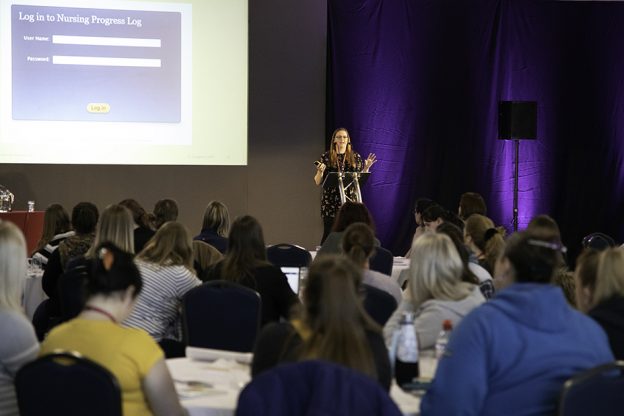
Tori Page delivers a talk at Clinical Coach Congress 2019

Clinical Coaches left motivated and inspired by Clinical Coach Congress 2019

Our annual Clinical Coach Congress, held from 18-19 March 2019, was a huge success and saw over 80 clinical coaches come together to share ideas and listen to lectures on student veterinary nurse training!

Delegates left the event feeling inspired and motivated, commenting: “I took away lots of great ideas and feel very motivated from the course, not only, as a [clinical coach] but as a member of the team.”, “I feel motivated and inspired by the speakers and have lots of useful tips and further reading material.” and “I enjoyed the lectures and enthusiasm from the speakers and feel much more motivated as a clinical coach.”

Clinical Coach Congress 2019 moved to the wonderful East of England Arena and Events Centre in Peterborough. This year’s congress included lectures on teaching techniques, coaching styles, student motivation, professional accountability, exam techniques – and much more. A commercial exhibition was held throughout the congress, and day one of the event closed with the launch of VetSkill’s Level 3 Diploma in Veterinary Nursing (Companion Animal); giving delegates the perfect opportunity to learn more about the new qualification and network with fellow clinical coaches.

Plans for Clinical Coach Congress 2020 will soon be underway. If you would like to keep up-to-date with news on next year’s Clinical Coach Congress can register their interest at www.caw.ac.uk/ccc

Clinical Coach Congress 2019 stage and delegates