Author Archives: Amber Tennant

Clinical Coaches left motivated and inspired by Clinical Coach Congress 2019

The College of Animal Welfare’s annual Clinical Coach Congress, held from 18-19 March 2019 and sponsored by Millpledge Veterinary, saw over 80 clinical coaches come together to share ideas and listen to lectures on student veterinary nurse training.

Delegates left the event feeling inspired and motivated, commenting: “I took away lots of great ideas and feel very motivated from the course, not only, as a [clinical coach] but as a member of the team.”, “I feel motivated and inspired by the speakers and have lots of useful tips and further reading material.” and “I enjoyed the lectures and enthusiasm from the speakers and feel much more motivated as a clinical coach.”

Clinical Coach Congress 2019 moved to the wonderful East of England Arena and Events Centre in Peterborough. This year’s congress included lectures on teaching techniques, coaching styles, student motivation, professional accountability, exam techniques – and much more. A commercial exhibition was held throughout the congress, and day one of the event closed with the launch of VetSkill’s Level 3 Diploma in Veterinary Nursing (Companion Animal); giving delegates the perfect opportunity to learn more about the new qualification and network with fellow clinical coaches.

Congress organiser, Tracey Croucher, said “We would like to thank all the speakers, exhibitors and delegates who attended Clinical Coach Congress this year, for making the event such a success. This event has now been running for 14 years and it’s always a pleasure to see so many enthusiastic clinical coaches come together and look at how to best support student veterinary nurses in practice”.

Plans for Clinical Coach Congress 2020 will soon be underway. Those interested in keeping up-to-date with news on next year’s Clinical Coach Congress can register their interest at www.caw.ac.uk/ccc

– Ends – 

Notes to editors:

The College of Animal Welfare is one of the UK’s leading providers of veterinary nurse and animal care training and education; operating from four training centres around the UK.

The College has a well-earned reputation for excellence and has created a number of unique achievements that have created new opportunities for learning.

For more information about The College of Animal Welfare please visit www.caw.ac.uk
International Day for the Elimination of Racial Discrimination (21 March)

Today is International Day for the Elimination of Racial Discrimination!

On this day, in 1960, police opened fire and killed 69 people at a peaceful demonstration in Sharpeville, South Africa, against the apartheid pass laws. Proclaiming the day in 1966, the United Nations General Assembly called on the international community to redouble its efforts to eliminate all forms of racial discrimination.

Although we have come a long way towards achieving racial equality since the United National proclaimed the day, there is still a long way to go. Take a look at simple things you can do day-to-day to challenge racial discrimination:

Start with yourself

It’s important to remember not everyone is raised in the same way and that we are all a product of our backgrounds. Be open to learning more about your own bias and make an effort to get to know other people – including their points of view, and the motivations and thought processes behind why they are the way they are.

Speak up against discrimination 

Don’t ignore discriminatory behaviour in others, even if you are close to them. Speaking up against discrimination when you see or experience it will help raise awareness, educate people and challenge others’ views.

Support others

Support others who are experiencing discrimination and encourage them to take the appropriate action needed to improve their situation; this could be anything from taking records of discrimination, pushing forward with workplace/legal procedures or seeking advice where necessary.

If you feel you are being discriminated against on placement, at work, or in College; please contact us. The College has a zero tolerance policy towards racial discrimination, whether intentional or unintentional. Incidents of discriminatory behaviour are a serious matter and will be dealt with appropriately.

Animal care apprentice blog cover image

National Apprenticeship Week: Grow your team with an animal care apprentice!

It’s National Apprenticeship Week!

If you’re looking to expand your team and take your business to the next level, there’s no better way to do so than investing in an animal care apprentice!

With the National Minimum Wage for Apprentices being just £3.70 per hour, it really is an affordable way to take on new staff. You will also be providing valuable experience and training opportunities for someone keen to start working with animals. What’s more…

You will cut your recruitment costs!

Boosting your team with an apprentice is a great way to bypass the added recruitment costs associated with outsourcing or recruiting skilled labour. You can save even more on recruitment costs when you take on an apprentice with The College of Animal Welfare. As part of the recruitment process, we can advertise, filter applications for you and even arrange your interviews if you wish – all for FREE! Take a look at the recruitment process

No need to attend College! 

As our apprenticeship programmes are work-based, you will not lose your apprentice to college time. Instead, all their learning will be delivered in the work place with support from a Work-based Learning Assessor. They will visit your apprentice on a regular basis, and provide telephone and email support between visits. Even better – apprentices no longer have to be full-time employees and can undertake an apprenticeship part-time too!

Gain an extra pair of hands for less!

Employers who take on an apprentice aged between 16-18 years of age will also receive a £1,000 incentive towards training fees. Further reductions available for organisations with less than 50 contracted employees. And, with the National Minimum Wage for Apprentices standing at £3.70 (April 2018), you can develop an apprentice for much less than it would cost to recruit for qualified labour.

Grow an employee who meets your business needs! 

Our apprenticeship will allow your apprentice to study core knowledge, skills and behaviours and then choose a specific pathway depending on their job role and interests; allowing you to tailor your apprentice to specific business objectives and needs.

Why choose The College of Animal Welfare as a training provider?

The College of Animal Welfare is one of the UKs leading providers of veterinary nurse and animal care training.

We are very proud of the fact that all of our staff delivering our animal care courses have significant industry experience and knowledge under their belts; they all share a common passion for pushing the profession forward.

Your apprentice will learn all the skills and knowledge needed to drive your business forward and become the best animal carers they can be. They will benefit from…

  • Tuition, support and assessment provided in the workplace, online and via email and telephone contact
  • Support and guidance from an allocated, qualified Work-based Learning Assessor
  • Access to our unique Virtual Learning Environment (VLE) and extensive eLibrary resources

If you would like to speak to a member of our team directly regarding animal care apprenticeship training, please contact us at admin@caw.ac.uk or on 01480 422060.

Further sources

Not looking to recruit? Develop your current staff instead!

Contrary to popular belief, apprenticeships aren’t just for people new to a job! They are a great path for people at any stage of their career – from those re-entering the workforce, to those wanting to reskill or change careers. If you would like to train an existing member of staff, your employee will need to select the programme they are interested in and apply online.

Animal care apprenticeships blog cover image

National Apprenticeship Week: Kick-start your career with an animal care apprenticeship!

It’s National Apprenticeship Week!

If you’ve always wanted to work with animals, have you considered making it happen by undertaking an animal care apprenticeship?

Contrary to popular belief, apprenticeships aren’t just for people new to a job! They are a great path for people at any stage of their career – from those re-entering the workforce, to those wanting to reskill or change careers.

Our new animal care and welfare assistant apprenticeship programme can give you the opportunity to gain work experience in an animal care environment, and give you the key practical skills and knowledge needed to kick-start a career in the industry. What’s more…

You’ll get paid for making the world a better place for animals – right from the get go!

As an animal care apprentice, on-the-job training means you will be paid for your efforts, and benefit from having a regular income. Apprentices will immediately start earning a wage when they begin employment.

Your employer will cover the cost of your training! 

An animal care apprenticeship is a debt free route to a career in animal care. Not only will you be earning a wage, you will have no course fees to pay as these are all paid by your employer! In other words, you will be gaining valuable experience in the workplace for FREE!

You can start at any time of the year

as you do not need to attend college. Instead, all your apprenticeship materials will be delivered via our Virtual Learning Environment (VLE) and you will be allocated a work-based learning assessor who will support you throughout the qualification via email and telephone contact and regular visits to your place of work.

You will benefit from tailored learning

The apprenticeship will allow you to study core knowledge, skills and behaviours and then choose a specific pathway depending on your job role and interests. You can choose from rehoming, animal interaction and handling, wildlife rehabilitation, breeding – and many more.

Why choose The College of Animal Welfare as a training provider?

The College of Animal Welfare has a well-earned reputation for excellence. Your apprentice will benefit from:

  • Tuition, support and assessment provided in the workplace, online and via email and telephone contact
  • Support and guidance from an allocated, qualified Work-based Learning Assessor
  • Access to our unique Virtual Learning Environment (VLE) and extensive eLibrary resources

If an animal care apprenticeship is the route for you, the first step is looking for an animal care apprenticeship vacancy and understanding more about the programme. Take a look at these sources to get started:

The College of Animal Welfare is hosting its popular Careers with Animals Day at its centre near Huntingdon on Saturday 30 March 2019! Don’t miss out on the opportunity to find out more about the training and employment opportunities within the veterinary care and animal care sectors. Entry is completely free of charge! Find out more at www.careerswithanimals.co.uk

Intensive dog grooming courses: Give your dog grooming skills the recognition they deserve!

If you’re an experienced dog groomer without a formal qualification, have you considered gaining official recognition of your skills and experience by undertaking an intensive version of the City & Guilds dog grooming qualifications? 

By undertaking a formal qualification, you will boost your professional credibility even further, helping you to gain more customers, pave the way to a promotion or expand your business.

Our intensive dog grooming courses are ideal for experienced groomers who are looking to brush up on their skills and gain professional groomer status. What’s more – the programmes primarily run in the evenings, making it easy to get formally qualified around a busy schedule! Read on to find out more…

City & Guilds Level 2 Certificate for Dog Grooming Assistants: Intensive, Experienced Groomers

This intensive course is ideal if you’re an experienced dog groomer who wants the opportunity to gain the level 2 City & Guilds qualification. You would attend four evening theory sessions and one or two practical sessions at College for assessment during the working day. Throughout the programme you will look at dog behaviour, animal health/basic first aid, legislation and exam techniques. The next programme begins on Wednesday 3rd April.

Completion of this course, provided you have five years full-time grooming experience, will also enable you to progress onto the Intensive Level 3 Diploma in Dog Grooming and achieve professional groomer status.

City & Guilds Level 3 Diploma in Dog Grooming: Intensive, Experienced Groomers

If you’re an experienced groomer who has achieved the City & Guilds Level 2 Certificate for Dog Grooming Assistants qualification and have at least five years of full-time grooming experience, this intensive course could be for you!

You will attend seven evening theory sessions and ten practical days for grooming support. You will then attend college for two days for your synoptic practical assessments which are completed under exam conditions. During the programme you will look at first aid, health and breed defects, risk assessments, customer service and basic business set up. The next course starts on Wednesday 15th May.

Our City & Guilds accredited dog grooming qualifications are all taught by qualified dog groomers with solid industry experience. To apply for the courses please visit our website.

Self-injury awareness day cover image

Self-Injury Awareness Day – learn more about how to help! (1 March)

Self-injury affects people from all walks of life, regardless of age, gender, sexual orientation, ethnicity, career, or personal strength; and it’s much more common than many people realise.

The UK has the highest self-injury rate of any country in Europe with estimates of 400 in 100,000 people self-harm. What’s more – these figures are likely to be higher as many people who self-harm do not tell anyone about it.*

In order to live in a world where people treat self-injury with understanding, and where you can talk freely about mental health instead of suffering in silence, it’s incredibly important to raise awareness about self-injury. Read on to find out more about self-injury and how you can help someone who may be struggling to cope:

What is Self-Injury?

Self-injury (also known as self-harm) is when somebody deliberately harms their own body. It’s often used as a way to cope with or express intense emotional distress caused by underlying problems in life. People self-harm for lots of different reasons, however overwhelming emotional issues could be caused by:

  • Social problems such as being bullied, having difficulties at work, having difficult relationships with friends/family, or coming to terms with their sexuality
  • Trauma such as physical/sexual abuse, the death of a loved one or having a miscarriage
  • Psychological causes such as having thoughts or voices telling them to self-harm, disassociating or borderline personality disorder

Although many people who self-harm do not want to end their lives, it’s important to know that sometimes the emotional distress leading to self-injury can also lead to thoughts of suicide, and self-injury can be a cry for help. Self-injury is also linked to anxiety and depression.

Types of self-injury

There are many different ways people can intentionally harm themselves, however most common forms of self-injury are:

  • Scratching
  • Cutting
  • Burning
  • Non-suicidal overdosing (chronic self-medication)

Indications of Self-Injury

Signs of self-injury can be hard to spot, as people who self-harm often hide their behaviour and keep their feelings to themselves because they’re ashamed or afraid of judgement. There may be no warning signs, but some of the things below might indicate that someone is suffering emotional distress and relying on self-injury:

  • Obvious cuts, scratches or burns that do not appear to be of an accidental nature
  • Frequent “accidents” that cause physical injury
  • Regularly bandaged arms and/or wrists
  • Taking more time off work either sick or to visit the doctor or hospital
  • Wearing long sleeves and trousers even during hot weather
  • Signs of low self-esteem, such as blaming themselves for any problems or thinking they’re not good enough for something
  • Self-loathing and expressing a wish to punish themselves
  • Becoming very withdrawn and not speaking to others
  • Signs of depression such as a low mood, tearfulness or lack of motivation or interest in anything

How to help someone who is self-injuring

If someone you care about is self-injuring, there are things you can do to help:

  • Let the person know you care about them and are available to listen
  • Focus on the underlying problems behind the person’s self-injury rather than the self-injury itself. Don’t ask to see their scars or about the methods they use – instead, ask them if there is anything that is making them unhappy or stressed that you could help with
  • Treat them as normally as you usually would. They are still the same person and self-injury does not make them weird or abnormal
  • Don’t show disgust or anger, any negativity will increase the person’s distress and may alienate them from you
  • Encourage the person to do things that make them happy
  • Don’t gossip or tell anyone else about the situation unless they ask you to, or they ever express a wish to end their life
  • Remember to take care of yourself – it is difficult coping with the self-injury of someone you care about, so don’t be afraid to seek extra support yourself.

How to help yourself if you’re self-injuring

If you’re using self-injury as a way to cope, you do not need to suffer in silence. Self-injury has nothing to do with personal strength and admitting that you need help is a sign of courage, not weakness.

The first step is speaking to your local GP. They will be able to treat any physical injuries, assess why you self-harm and recommend treatment/further assessment if needed.
Find your nearest GP services

There are also many organisations that can offer support and guidance for people who self-harm (as well as friends, families and co-workers) including:

The College of Animal Welfare presents collaborative research at ICRTEL 2019

BC eurasia conference1Barbara Cooper (Principal at The College of Animal Welfare), Nina De Franco (Head of Veterinary Studies at The College of Animal Welfare) and Tina Moore (Lecturer at Middlesex University, London) presented a research paper on Modernising the OSCE assessment in Veterinary Nursing at the International Conference on Research in Teaching, Education & Learning (ICRTEL) in Dubai from 24-25 February.

The annual conference allows researchers, practitioners and educators to come together to share information in the field of teaching and learning. Key note speakers included:

  • Aseel Zibin,  Assistant Professor of Linguists and English at the University of Jordan
  • Anna Pfennig, Head of Technical Studies and Life Sciences from the University of Applied Sciences in Berlin
  • Dr Abdel Rahman Mitib Altakhaineh from the UAE
  • Professor Wadesango from the University of Limpopo in South Africa

Research papers were all presented in English on a variety of educational topics with representatives from all over the world. Nina De Franco shared with the audience the approach proposed with the implementation of Holistic Assessment of Clinical Skills (HACS).

Papers of particular note included the use of the inverted classroom scenarios, blended learning concepts and the impact of lecture films on study behaviour. An overview of the teaching methods in the art of ballet highlighted how knowledge and skills were only part of what made a successful ballet dancer. A key feature was the measurement of how they use their soul to express their movement. Interesting parallels were drawn to measuring the behavioural skills required of learners following other disciplines.

A session looking at teacher expectations raised some thought provoking ideas that showed that learner age is rarely an influencing factor. Cultural issues were highlighted in a session exploring early childhood educators responses to children’s interpersonal sexual behaviours. The effects of professionalisation of teaching on pedagogical skills of academics, as experienced by one postgraduate diploma in Higher Education, was explored; indicating that all educators have a responsibility to keep themselves up-to-date with current learner perception and approaches to learner preference.

BC eurasia conference4

BC eurasia conference2


Save 30% on boarding fees this Spring at Campus Vets and Pets!

With flowers beginning to bloom and the Easter holidays fast approaching, if you’re planning on making a getaway this Spring, now is the time to be finding somewhere for your cat or dog to stay…

Why not consider the Campus Vets and Pets (located at our Leeds centre) luxury boarding kennels and cattery for your beloved pet?

At Campus Vets and Pets your pet(s) will benefit from…

  • A fully insured premises
  • An on-site veterinary practice and dog grooming service
  • 24/7 CCTV security
  • Friendly and caring staff

All breeds of cat and dog are welcome. Prices remain the same throughout the year, and discounts are available on multiple dogs, or multiple cats, from the same family. What’s more – if you’re a student or staff member at The College of Animal Welfare, you can save 30% on boarding fees this Spring! See prices

Located just off of junction 28 of the M62 with free onsite parking, Campus Vets and Pets is easily commutable from: Morley, Batley, Wakefield, Dewsbury, Leeds and Pontefract. Get directions from your postcode

Book your pet in for a stay today!

Campus Vets and Pets is open all year round and throughout the Easter holidays, but spaces are now filling up! If you would like to book your pet in to stay, call the boarding team on 0113 467 8650.

To find out more about our facilities and view our pricing structure, please visit the Campus Vets and Pets website.

RCVS Council election candidates and new VN Council member announced

The Royal College of Veterinary Surgeons (RCVS) has announced the candidates standing in the 2019 RCVS Council elections.

There are nine candidates standing in this year’s RCVS Council election. They are:

  • Dr Linda Belton MRCVS
  • Dr Niall Connell MRCVS
  • Mr John C Davies MRCVS
  • Dr Joanna (Jo) Dyer MRCVS
  • Professor Timothy (Tim) Greet FRCVS
  • Professor John Innes FRCVS
  • Dr Thomas (Tom) Lonsdale MRCVS
  • Dr Katherine (Kate) Richards MRCVS
  • Mr Peter Robinson MRCVS

Ballot papers and candidate details for the RCVS Council election are due to be posted and emailed to all veterinary surgeons eligible to vote during the week commencing 25 March. All votes must be cast, either online or by post, by 5pm on Friday 26 April 2019. For more information about each candidate, including biographies and statements, visit www.rcvs.org.uk/vetvote19.

In order to give the electorate the opportunity to learn more about why each candidate is standing and ask them for their views on particular issues, the college is inviting members of the profession to ask questions directly to the candidates. Each candidate will then produce a video recording their answers to two questions of their choice. Recordings will be published on the RCVS website and YouTube channel on the week the election commences.

Vets should email their question to vetvote19@rcvs.org.uk or send it to the College’s Twitter account @theRCVS using the hashtag #vetvote19 by midday on Monday 4 March 2019.

New VN Council member announced

This year there will be no election for Veterinary Nurses (VN) Council as only two candidates – current VN Council Vice-Chair Liz Cox and newcomer Jane Davidson – stood for the two available places for elected members. Both Liz and Jane will start their three-year terms on VN Council at Royal College Day on Friday 12 July 2019.

Veterinary nursing April 2019 website advert

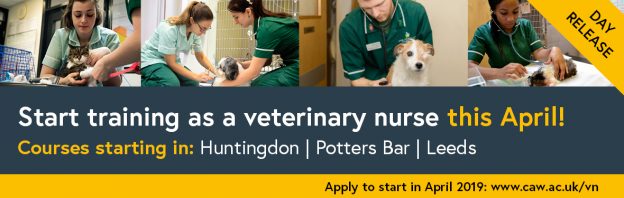
Start training as a veterinary nurse this April!

If you’re looking to kick-start a career as a veterinary nurse this year, don’t wait until September – you can start training as soon as April 2019 at The College of Animal Welfare!

Veterinary nursing is the perfect job for those looking for a varied, challenging and rewarding career where you will make a difference to the lives of animals every single day. What’s more – there’s a nationwide shortage of veterinary nurses, so job prospects on completion of formal training are excellent.

Our next day release courses begin in April 2019 from our Huntingdon, Potters Bar and Leeds centre, and there’s still time to apply!

As a day release student, you would attend college one day per week. Outside of college you will gain practical experience in a suitable veterinary practice, either as a paid employee or a non-employed student on work placement. There are also apprenticeship options available.

To apply to start training this April, please visit our website.