Author Archives: Amber Tennant

Level 3 Diploma in Veterinary Nursing (Equine Pathway) now available!

We are thrilled to announce that we now offer the City & Guilds Level 3 Diploma in Veterinary Nursing (Equine Pathway) qualification!

Available to start in February on a block release basis from our Huntingdon centre, the opportunity to study this recognised qualification is set to be in high demand!

The role of an Equine Veterinary Nurse is a varied role, with no two days the same. As an equine veterinary nursing student, you will have the chance to study with like minded people and become a highly valued member of practice. Throughout the programme you will cover emergency and critical care, neonatal care, pre-operative support for horses – and much more!

With the course starting soon, enrolment is now open! For more information about the course, and details about how to apply, visit www.caw.ac.uk/equinevn

FREE Training Practice Approval to equine veterinary practices before 31 December 2019!

To study this course, students must be working in an equine or mixed (equine and small animal) veterinary practice that is approved by the Royal College of Veterinary Surgeons (RCVS) to train veterinary nurses; a Training Practice (TP) or Auxiliary Training Practice (aTP).

In order to celebrate the launch of this new course, we are pleased to offer free Training Practice approval to any equine veterinary practice that submits their completed TP application form back to the College before 31 December 2019.

We are also in a position to support block release students with accommodation throughout their training if required. For further information on availability and associated costs please contact us.

fast track dog grooming courses

NEW fast track dog grooming courses open to experienced groomers!

If you’re an experienced dog groomer without a formal qualification, have you considered gaining official recognition of your skills and experience by undertaking the Level 2 Certificate for Dog Grooming Assistants: Fast Track, Experienced Groomers course?

Accredited by City & Guilds, the fast track version of this course is ideal for experienced groomers who are looking to brush up on their skills and gain professional groomer status. What’s more – the programmes primarily run in the evenings, making it easy to get formally qualified around a busy schedule!

By undertaking a formal qualification, you will boost your professional credibility even further, perhaps paving the way to a promotion or expanding your own business. Read on to find out more about the programme…

City & Guilds Level 2 Certificate for Dog Grooming Assistants: Fast Track, Experienced Groomers

This fast track course is ideal if you’re an experienced dog groomer who wants the opportunity to gain the level 2 City & Guilds qualification. You would attend four evening theory sessions and one or two practical sessions at College for assessment during the working day. Over the course of the programme you will look at dog behavior, animal health/basic first aid, legislation and exam techniques.

Completion of this course, provided you have five years full-time grooming experience, will also enable you to progress onto the Fast Track Level 3 Diploma in Dog Grooming* (planned for 2019) and achieve professional groomer status.

The next programme begins on Wednesday 20 February 2019 from our Huntingdon centre, and there’s still time to apply! For more information about the course, and details about how to apply, please visit our website.

*If you intend to progress onto the level 3 diploma fast track course please contact us about fees at the point of enrolling for the fast-track level 2 programme, as discounts apply for those booking both courses at the same time.  

Level 3 Diploma in Veterinary Nursing Block Release

There’s still time to start training as a veterinary nurse this February!

Do you dream of working with animals? Perhaps you’re stuck in a dead end job that doesn’t inspire you, and long to earn a living from doing something you love…

For those looking for a new career working with animals, don’t just wish it would happen – make 2019 the year you turn your dreams into a reality and begin training as a veterinary nurse!

Veterinary nursing is the perfect job for those looking for a varied, challenging and rewarding career where you will make a difference to the lives of animals every single day. What’s more – there’s a nationwide shortage of veterinary nurses, so job prospects on completion of formal training are excellent. But that’s not all…

If you choose to undertake veterinary nurse training on a block release basis, you could start on your journey to a new career as early as next month!

Our next block release course begins in February 2019 at our Huntingdon centre, and there’s still time to apply!

As a block release student, you would attend college in two week blocks, four times per year and be supported by online learning. Outside of college you will gain practical experience in a suitable veterinary practice, either as a paid employee or a non-employed student on work placement. There are also apprenticeship options available.

Traditionally block release programmes have much smaller class sizes than day release programmes, so could be ideal if you prefer more intimate classes or are located too far from college to travel in weekly.

For more information about block release training, and details about how to apply, please visit our website.

Student Veterinary Nurse with Coach-1

Join our FREE webinar for clinical coaches supporting BSc students!

If you’re a clinical coach supporting a CAW BSc veterinary nursing student in practice,
join us on Monday 7th January 2019 from 7.30-9.30pm for our FREE webinar!

The webinar can be counted towards CPD hours and will look at:

  • The structure of the Middlesex/CAW BSc (Hons) programme
  • Key modules and placement blocks that are crucial to student progression
  • Key issues faced by clinical coaches of BSc students and how to resolve them
  • How to apply the behavioural tool document to your student’s action plans
  • How and where you can access appropriate support
  • The importance of the health and safety, and safeguarding of placement students

To register for the webinar please visit the Go To Webinar website.

Wildlife conservation tips in your garden - fb cover

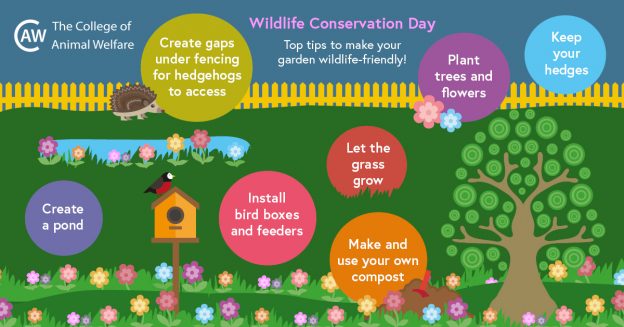
Wildlife Conservation Day: Top Tips to make your garden more wildlife-friendly! (4 Dec)

According to reports, more than one in 10 of the UK’s wildlife species are threatened with extinction.

If you’re interested in being involved in wildlife conservation, why not start at home? There are many ways you can make your patch a little greener, and keep wildlife thriving in your garden…

  • Grow flowers: Not only do flowers look beautiful and bring colour and life into your garden, they are also essential to bees and provide food for many insects. Choose different plants that flower the longest (providing pollen and nectar) and ditch the pesticides!
  • Create a pond: Installing a small pond would be a great boost for wildlife, and it doesn’t need to be big or complicated! You can use a buried bucket or trough but remember to make sure there is a way out or at least one sloping side for animals that may fall in by accident.
  • Install a birdhouse or feeder: Give birds a place to stay in your garden by installing a birdhouse or feeder. You could buy one or make your own!
  • Make and use your own compost in your garden: Making and using your own compost will naturally enrich your soil, and also provide a habitat for worms and woodlice.
  • Relax about weeds: There’s no need to stress about weeds! Plants such as nettles and daisies are an important source of food for many insects including butterflies and moths.
  • Create a space for insects: You can leave piles of rocks and twigs in an area of your garden, to create shelter for all sorts insects such as beetles and spiders.
  • Let the grass grow: Longer grass is the perfect habitat for many plant and insect species to thrive, including butterflies and wildflowers. By letting some or all of your lawn grow, you’ll be leaving more space for wildlife to grow!
  • Keep your hedges: Native hedges or a mix of trees and shrubs will naturally create safe shelters or nesting sites for the larger animals and also food sources for a variety of creatures.
  • Use gapped fencing: Don’t lock out hedgehogs from your garden! Where possible, use gapped fencing or create small gaps under your fences to create easy access for hedgehogs.

Wildlife Conservation Day is a global awareness initiative that aims to provide people with the opportunity to learn more about wildlife conservation and to be part of the solution to common threats to endangered species, including poaching, commercial and residential developments, climate change and pollution. To find out more visit https://www.wwf.org.uk/

Want to learn more about environmental conservation? Study our Level 2 Diploma in Countryside and Environment!

Trees of green, red roses too…isn’t nature wonderful? If you love being outdoors, are interested in the environment around you and are fascinated by wildlife and different habitats, why not learn more?
 
Our Level 2 Diploma in Countryside and Environment gives you the freedom to study in your own time, at your own pace. Throughout this online course you’ll gain an introduction the principles behind environmental management and conservation, learning about ecological surveys, conserving British habitats, land-based business – and much more! 


Nominations for VN Council 2019 elections now open

Nominations are now open for veterinary nurses who are eligible to stand for Veterinary Nurses (VN) Council, for next year’s elections.

The nomination period for the VN Council runs until 5pm on Thursday 31 January 2019. In order to stand, candidates need to complete a nomination form, submit a short biography and personal statement and supply a high resolution digital photo.

Each candidate will also need to have two nominators. For VN Council candidates, the nominators must be registered veterinary nurses who are not currently on VN Council.

Nomination forms, guidance notes and frequently asked questions for prospective VN Council candidates are available at www.rcvs.org.uk/vncouncil19. For more information please visit the RCVS website.

World Aid's Day 2018 promotional poster

World Aids Day: Common Questions Answered!

World Aids Day is a national awareness campaign dedicated to highlighting the AIDS pandemic caused by the spread of HIV infection, and mourning those who have died of the disease.

World Aids Day is also about pushing against the ignorance that still limits the opportunities of over 100,000 people living with HIV in the UK. People living with HIV are more likely to live in poverty, and more likely to have poor mental health. Discrimination is also rife, with one third of people living with HIV in the UK having experienced discrimination. [1] Take a look at some of the most common questions about HIV answered…

What’s the difference between HIV and aids?

Somebody who has the HIV virus in their body is described as living with HIV; whereas a person is described as having developed aids when the immune system is no longer strong enough to protect the body against diseases it would usually cope with easily.

How is HIV passed on?

The most common ways HIV is transmitted is through sex without a condom and sharing infected needles, syringes or other injecting drug equipment.

MYTH: HIV can be passed on through saliva, sweat, urine, day-to-day contact, sharing utensils, kissing or biting.
FACT: HIV does not survive for long outside of the body; the most common forms of HIV transmission are sex without a condom, oral sex without a condom (very low risk) or sharing a needle or injecting equipment with a HIV positive person. A small number of people living with HIV in the UK acquired it before or soon after birth (‘vertical’ or ‘mother-to-child’ transmission). [2]

Who is at risk of HIV infection?

Anyone that is having sex without a condom is putting themselves at risk. While some groups in the UK carry a disproportionate burden of HIV (for instance, around 1 in 20 men who has sex with men is living with HIV in comparison to around 1 in 525 in the UK population overall), 25% of people diagnosed with the condition in the UK are not in any of these groups. [3]

What are the symptoms of HIV?

70-90% of people experience various symptoms within the first three months of acquiring HIV, including flu-like symptoms, headaches, mouth ulcers, night sweats, weight loss and swollen glands. [4] After these symptoms have subsided, it is possible for a person to live for many years without any indication that they have the virus. This is why it is important to get tested as soon as you believe you have put yourself as risk of HIV infection, as the lack of any symptoms thereafter means that the virus can strengthen for years before treatment can be started.

I have put myself at risk of HIV. What should I do?

If you believe you may have exposed yourself to HIV, it is important that you seek a diagnosis as soon as possible. You can do this by taking a free, and completely confidential, test at your local sexual health clinic to determine whether you have HIV. Alternatively, you can get a self-testing kit if you would prefer to take a test at home.

If you have put yourself at risk and it is within 72 hours of possible exposure to HIV, you can look into Post Exposure Prohylaxis (PEP) treatment from a sexual health clinic or A&E; PEP will not necessarily prevent HIV infection, however it is more effective the sooner it is taken.

What can I do to help?

  • Campaign:Contact your local MP and ensure they are showing leadership on HIV. Make sure they understand the needs and priorities of their constituents who are living with or affected by HIV.
  • Educate:Download campaign resources from the World Aid’s Day website, and turn your school or workplace into an education hub. Encourage people to learn more about the history of HIV, what life with HIV is like, and how to protect themselves from being at risk of HIV. Fight stigma by breaking down the many myths surrounding HIV.
  • Fundraise: Get involved! There are many fundraising activitieswhich can raise vital funds for the National Aids Trust (NAT). Doing so will ensure NAT continues to champion the rights of people with HIV and campaign for policy change. Download NATs fundraising pack
  • Volunteer:NAT offer volunteering opportunities with the following teams in its central London office: administration, communications, finance, fundraising and policy/campaigns. If you are interested in volunteering with NAT, send them a message and they will try to match you with relevant upcoming opportunities.
To find out more about World Aid’s Day, visit National Aids Trust website.

sunset at the beach - self care week blog

Self Care Week: 5 simple ways you can boost your wellbeing today!

Healthy living isn’t just about what you eat for dinner or how often you’re in the gym. Taking time out to focus on yourself is essential to emotional and mental wellbeing. However, it isn’t always easy to fit in, especially if you’re juggling a busy home or professional life.

This self care week, take a look at these 5 simple things you can do for your wellbeing, which don’t take up a lot of time and can slot into busy routines more easily:

  1. Watch the sunrise or sunset

Any time you can make in your life to pause and simply breathe is a good way to boost mental wellbeing. Making a point to watch the day begin and end each day is a perfect way to slow down. What’s more – you can enjoy the sunlight at its most colourful! (Don’t take any pictures or post about it on social media, just watch!)

2. Take a leisurely walk

A short walk around the block or your local park in the sunshine can help clear your mind of worries or distractions, and just focus on the ‘here and now’ for a while.

3. Listen to a feel-good playlist/podcast

Wind down from a busy day by listening to your favourite songs, or a short podcast on a topic that interests you.

4. Read a book or magazine

Taking the time out to read something for pleasure can help you relax. According to studies, reading for just six minutes a day is enough to reduce stress levels by up to 65%.

5. Declutter your house or wardrobe

Taking the time to clean up a cluttered area that has been bothering you for a while, or give away clothes you don’t really need, can help you feel more organised. As they say, a tidy home equals a tidy mind!

Changes to Pet Travel in the event of a ‘No-Deal’ Brexit

The Department for Environment, Food and Rural Affairs (Defra) has advised that should the UK leave the EU next year without a deal, pet owners wishing to travel to the EU will need to take some additional steps to be able to travel.

If you are planning to travel after 29 March 2019, you will need to contact your vet at least four months in advance of your travel date to make sure your pets are microchipped and vaccinated against rabies.

Those wishing to travel to the EU on 30 March 2019, therefore, should discuss requirements with their vet as soon as possible and by 28 November 2018 at the latest.

The Government has published further guidance for pet owners on its website.

Save 30% on kennel and cattery boarding fees this Christmas

Save 30% on boarding fees this Christmas at Campus Vets and Pets!

Calling all students at The College of Animal Welfare…

With Christmas just around the corner, if you’re planning on making a festive getaway this year, why not consider the Campus Vets and Pets luxury boarding kennels and cattery (based at our Leeds centre) for your pet?

At Campus Vets and Pets, your pet(s) will benefit from…

  • Fully insured premises
  • An on-site veterinary practice and grooming facilities
  • 24/7 CCTV security
  • Friendly and caring staff

All breeds of cat and dog are welcome, and Campus Vets and Pets offer discounts on multiple dogs, or multiple cats, from the same family. What’s more – as a student at The College of Animal Welfare, you can save 30% on all boarding stays this Christmas!

If you would like to book your pet in to stay at Campus Vets and Pets, call the boarding team on 0113 467 8650. To find out more about the facilities and view a pricing structure, please visit www.campusvetsandpets.co.uk/boarding