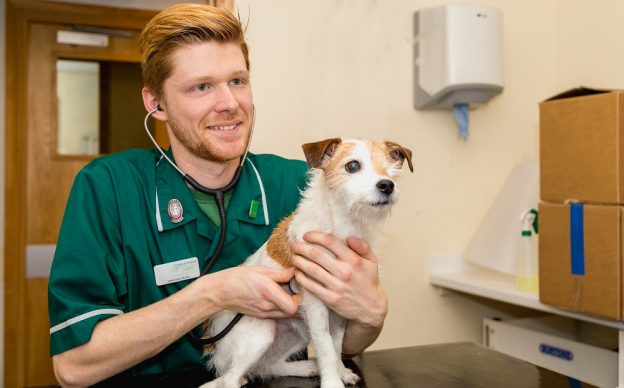
Vet Times is looking for student veterinary nurses (SVNs) to submit articles to the student section of its website.
They are looking for budding writers to provide content which is of interest to both current and prospective SVNs alike. This includes the experiences, successes and failures that come with studying veterinary nursing, extracurricular activites, and all the things that go hand-in-hand with being an SVN in the current economic and political climate!
Each post will receive remuneration based on a number of factors (content, length, commissioned topic, supporting material, etc) but will generally range from £20-£75. This will also allow authors who wish to commit to a series of shorter items the opportunity to do so, for which they would receive individual payment per post. Video blogs will also be considered.
Whether you want to air a personal opinion in a short blog post (350 words minimum), or fancy trying your hand at producing more in-depth content that involves a degree of research and/or specialist knowledge, find out more by contacting jackiemorrison@vbd.co.uk
Clinical Coach Congress 2019 open for registration!
We are delighted to announce that Clinical Coach Congress 2019, the UK’s largest conference dedicated solely to supporting clinical coaches and those involved in veterinary nurse training, is now open for registration!
Running from 18-19 March 2019, this year’s congress is moving to the wonderful East of England Arena and Events Centre in Peterborough. The East of England Arena is a multi-purpose events venue, offering generous conference space and state-of-the-art facilities. For those looking to stay overnight, discounted room rates are available to all delegates at the Marriot Hotel just five minutes away from congress.
This year’s event will include lectures on exam techniques, professional accountabilities, motivating students, coaching styles and the new veterinary nursing apprenticeship standard. Delegates will be able to speak to a variety of exhibitors from across the veterinary profession, and be part of the official launch of VetSkill’s new veterinary nursing qualification.
What’s more – Clinical Coach Congress is recognised by the Royal College of Veterinary Surgeons (RCVS) as clinical coach standardisation, meaning it is the ideal opportunity to network with fellow clinical coaches and can be counted towards CPD hours!
Be an early bird and book before 31 January 2019!
Delegates who book before 31 January 2019 will be able to attend both days of congress for the fantastic early bird price of just £249+VAT. A full event agenda, and further details about how to book, can be found at www.caw.ac.uk/ccc or by calling 01480 422060.
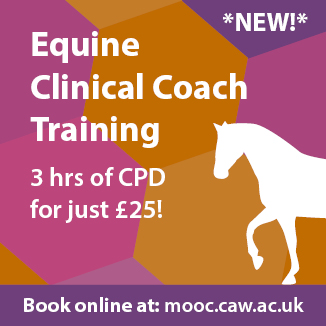
*New!* Online Equine Clinical Coach Training
Calling all clinical coaches!
We are delighted to announce that we now offer online Equine Clinical Coach Training.
The course is designed for veterinary nurses or surgeons who will be acting as clinical coach for student veterinary nurses within equine practice. The course will be particularly helpful for those struggling to arrange to take time out of practice for standardisation training. What’s more – the training is just £25!
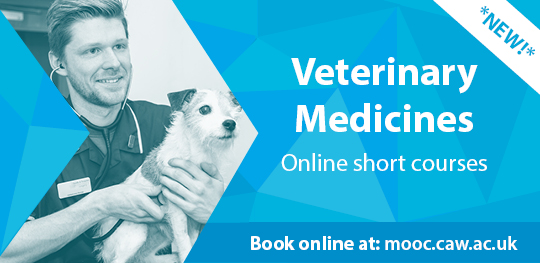
We are delighted to announce that a selection of online short courses covering veterinary medicines have been added to our growing portfolio of Massive Open Online Courses (MOOCs).
Perfect for Suitably Qualified Persons (SQPs) and those working in veterinary practice, the new short courses cover lipid infusions, parasiticides and what pet owners need to know about veterinary medicines.
The new courses (priced at £20) can be found and booked online at https://mooc.caw.ac.uk/ and are also available on the College’s CPD site under ‘Online CPD courses’.
BVA calls on vets to help tackle extreme conformation across all species
The British Veterinary Association (BVA) has presented a set of guiding principles and recommendations to support the veterinary profession in tackling extreme conformations in companion and farm animal species.
The position follows increasing concerns among the profession about breeding and conformation-related problems. In BVA’s Voice of the Veterinary Profession survey last year, breeding and hereditary defects emerged as vets’ top animal welfare concern. Nearly half (45%) of companion animal vets surveyed picked conformational deformities and pedigree breeding, particularly of brachycephalic breeds, among the three welfare issues that concerns them most.
The principles address the responsibility of society, including vets and vet nurses, to work together to:
ensure healthier future generations of animals that currently experience extreme conformation
reduce the negative health and welfare impacts of extreme conformation
increase awareness about these issues across different species
encourage research to better understand and address the prevalence of conformation-related ill-health
encourage research to better understand and address the prevalence of the welfare impacts resulting from extreme conformation
develop objective, robust measures to contribute to the assessment of problematic conformation.
This position also champions the vital role of the veterinary professions in influencing the reduction in the breeding of unhealthy animals with extreme conformation, as well as improving the wellbeing of current generations of animals.
Recommendations presented to achieve this include:
Supporting breeders to make responsible breeding decisions
Performing corrective surgical procedures and participating in reporting schemes where they exist
Monitoring health records and reports, such as abattoir and Food Standards Agency reports, to identify the impact of extreme conformation in livestock
For more information please visit the BVA website.
World Food Day – 5 ways you can help tackle food poverty in the UK!
The UK may be the seventh richest country in the world, but rising living costs combined with stagnating wages is leaving many people struggling to afford food.
Recent figures from the UK’s largest foodbank network, the Trussell Trust, show that demand for free emergency food parcels in the UK is rising each year. The problem is best illustrated by these worrying statistics from Oxfam:
It is estimated that over 500,000 people in the UK are now relying on food parcels.
Over 2 million people in the UK are estimated to be malnourished, and 3 million are at risk of becoming so.
36% of the UK population are just one unexpected bill away from financial hardship
Four million UK children live in households that are too poor to afford a healthy diet*
1 in 6 parents have gone without food themselves to afford to feed their families.*
One in four low-income families struggle to eat regularly.*
How you can help tackle food poverty in the UK
Tackling food poverty is one of today’s most urgent challenges if we are to cut the rising trend of hunger, obesity and diet related ill-health. You can help to make a difference by…
Donating food to a foodbank: Foodbanks are always looking for food donations from a standard shopping list. If you wish to donate food, it is worth calling in advance to find out what items are needed most.
Offering a financial gift: Foodbanks accept monetary gifts as well as food donations, and often giving money directly means there is more flexibility to buy what is needed the most.
Volunteering your time: Many charities rely on volunteers to help run foodbanks and raise awareness of food poverty. From administration, deliveries, supermarket collections or marketing/PR – there are many roles up for grabs and any contribution you can make will help make a real difference to the life of someone in crisis.
Fundraising for The Trussell Trust: Raising money for the Trussell Trust will ensure the charity can continue to run foodbanks and develop additional services to help break the cycle of poverty. Not only this, but fundraising can help you gain new skills and meet new people in your community.
Lobbying your local MP and supermarkets: By encouraging your local MP to visit your local foodbank and engage with its users first-hand, you can do your bit to make sure food poverty is at the top of their political agenda. You can also support the many social enterprises around the country, who are connecting food waste created in supermarkets and manufacturing chains with charities supporting people in need.
If you would like to find out more about how you can support your local foodbank, you can find the contact details for your nearest foodbank by entering your postcode on the Trussell Trust website.
“The whole day was absolutely fantastic!” Careers With Animals Day is a huge success with visitors!
The College of Animal Welfare’s annual Careers With Animals Day was the place to be on Saturday 13 October, as hundreds of people of all ages and backgrounds visited the College’s centre in Tingley to find out more about how they could turn their dream of working with animals into a reality.
With over 450 visitors dropping by to speak to exhibitors about the opportunities up for grabs in the animal care industry; this year’s Careers With Animals Day has been the centre’s largest careers event to-date. Careers talks running throughout the day covered everything from veterinary nursing and dog grooming, to hydrotherapy and veterinary medicine. One visitor said: “I thought the day was organised exceptionally well and I really enjoyed the variety of exhibitors at the event. It’s been great to meet with those already in the industry.” Another, “All the members of the college [were] really welcoming. I’ve had a well informed and lovely day.”
Event organiser, Claire Gregory, said: “It was wonderful to see so many people come together to find out more about the wide range of career opportunities in the animal care industry!” She added: “We would like to give a huge thank you to the variety of fantastic organisations who supported the event by exhibiting and delivering careers talks throughout the day.”
Preparations for next year’s event are already underway; details will be available shortly at www.careerswithanimals.co.uk For those who missed the event, but are interested in finding out more about the courses available at the College, the next course open day is Wednesday 24 October 2018 from 1pm-3pm. Further details can be found at www.caw.ac.uk
Veterinary Nursing Lecturer: Is it the role for you?
Becoming a veterinary nursing lecturer is a great opportunity for veterinary nurses to pass on their specialist skills and knowledge to future generations. The first question you need to ask yourself is whether you see yourself making that change and entering a new industry.
Will you be happy to step away from veterinary practice?
Being a lecturer is very different to working in a veterinary practice. Direct contact with animals will take a back seat to supporting students through their formal qualifications. Lecturing is often seen to be a standard ‘nine-to-five’ role, however there is also research, student support, marking and so on, which mean lecturers can sometimes work outside of these hours and during term holidays too.
You need to make sure that you understand what the move will involve and what your new role will look like day-to-day. You may wish to approach those who are already in the industry for their experiences and advice about the role.
Am I qualified to be a veterinary nursing lecturer?
You need to find out whether you are qualified to become a lecturer and, if not, what you might need to do in order to fit the entry requirements. The level of education required to become a veterinary nursing lecturer will vary depending on the role.
Generally, colleges ask that veterinary nursing lecturers need to be either a veterinary surgeon or a registered veterinary nurse, preferably holding a relevant teaching qualification such as the Level 3 Award in Education and Training.
In addition, whilst it is not essential, relevant student and teaching/training experience gained as a clinical coach, in voluntary or work shadowing capacity, is useful. Classroom experience would also be beneficial as it helps with understanding learner needs in a diverse and equal opportunities setting.
It is worth noting that the most common misconception about becoming a veterinary nursing lecturer is that you already have to have a teaching qualification in order to get into the academic profession. Although this would be a distinct advantage, it is worth doing some research into potential employers and getting in touch. Some employers (including The College of Animal Welfare) may be willing to fund your teaching qualification and allow you to work towards this whilst on-the-job.
Finding a Job as a Veterinary Nursing Lecturer
Finding a position
There are many online job platforms, which cater for the veterinary industry. On these websites, you can find all the latest vacancies in the veterinary world – including any veterinary nursing positions that may be available in your area.
Jobs in veterinary teaching are competitive in comparison to the number of jobs available for veterinary surgeons or RVNs working in practice. It’s important that your job application is as good as it can be and stands out from the crowd.
I don’t have any direct teaching experience. What experience should I highlight in my application?
The role of a veterinary nursing lecturer is wide-ranging, and can include responsibilities such as:
Writing and developing course content
Planning and presenting lectures, tutorials, seminars, workshops and practical teaching activity
Student support and guidance
Undertaking research and representing your organisation at conferences, seminars and exhibitions
Responsibilities will vary depending on the role, however the above list gives you a starting point to see what sort of skills an employer may be looking for. Take each responsibility and compare it with your own experience:
Have you ever done any public speaking that could be similar to presenting lectures?
Has your role in practice ever involved providing guidance to new graduates or recruits?
Have you ever completed any research, whether as part of a formal qualification or from personal interest?
Do you have any work that has been published, whether as part of formal research or from personal hobbies and interests such as a blog?
If you have answered “yes” to any of these questions, then make sure to highlight this experience on your application, and be ready to talk about it at interview!
If you have little experience in a direct teaching role, it may be worth seeking out more opportunities that require soft teaching skills. For example you could take on a clinical coaching role, lead a nursing consultation, or run a Continuing Professional Development (CPD) course for a local training provider. Not only will this help to strengthen your application when applying for lecturing roles, but it will help you get a real feel for how you take to teaching.
Veterinary nurses who do not hold a degree may also look to ‘top up’ their diploma to degree level by undertaking the BSc Honours Veterinary Nursing Top Up Programme (delivered by Middlesex University in conjunction with The College of Animal Welfare).
Beyond experience and qualifications…
Remember, although teaching experience and a relevant qualification is preferable, it is not essential to entering the field as a veterinary nursing lecturer. Some employers are willing to offer full training to candidates who demonstrate the drive and ambition needed to enter education.
Beyond experience, explain why you feel becoming a veterinary nursing lecturer is the right move for your career. Be prepared to answer questions about why you’re moving away from practice life, and show passion and enthusiasm for the profession.
The College of Animal Welfare offer the opportunity for veterinary nurses interested in lecturing to experience first-hand ‘a day in the life of’ by arranging lecturing shadow days. That way, you can see how the day develops from start to finish, see what the role involves and get more of an idea if it is for you. If you’re interested in finding out more about shadowing a lecturer at CAW, you can contact our HR team on 01480 422060.
If you want to find out a bit more about the role of a VN lecturer, you can watch our Day In The Life interview below!
Important information regarding VN Registration
Please note this advice is aimed at students of The College of Animal Welfare. Students studying at other training providers are advised to contact them directly if they have any questions or concerns regarding VN registration.
The Royal College of Veterinary Surgeons (RCVS) have recently made some changes to the process by which student veterinary nurses apply to join the RCVS Register of Veterinary Nurses.
Under the new process, awarding bodies will inform the RCVS directly when they issue a veterinary nursing qualification to a student. Once the RCVS receive this information they will then email the student directly within one week, providing them with a link to a new online portal. The student will then be required to upload their evidence of having completed the required 2,990 hours of practical training.
During this period of transition, once students receive their email from the RCVS they will need to contact us for a copy of their record of training and then upload it to the online portal to complete the registration process. If you have any questions please contact us on admin@caw.ac.uk / 01480 422060.
Careers With Animals Day to show the diversity of options open to veterinary nurses
For veterinary nurses looking to learn more about their career options, there’s no better place to start than The College of Animal Welfare’s (CAW) annual Careers With Animals Day!
Running at the College’s education and training centre in Tingley on Saturday 13 October, veterinary nurses will be able to chat to members of the CAW team about the opportunities open to them in industry – from veterinary team management and research, to teaching and rehabilitation.
A great line up of local and national exhibitors will be on hand to help vet nurses gain an insight into their respective specialisms, and work out whether it might be for them.
Exhibitors include Torrington Orthopaedics, Calder Vets, The Association of Chartered Physiotherapists in Animal Therapy (ACPAT), Paragon Veterinary Referrals, Abbey House Veterinary Hospital, Paddlin Paws, Cloud 9 Veterinary Physiotherapy – and many more.
As well as chatting to exhibitors, visitors can also listen to a jam-packed timetable of careers talks being held throughout the day on careers ranging from conservation work to hydrotherapy. What’s more – entry is completely free of charge!
Frank Taylor, Vice Principal Veterinary Studies at The College of Animal Welfare, said: “The career prospects for registered veterinary nurses are excellent. Whilst many choose to remain in first opinion veterinary practice after qualifying, there are just as many opportunities for progression in referral centres and large veterinary hospitals, as well as outside of practice. Careers With Animals Day is a fantastic opportunity to find out more about your options from industry professionals.”
Whether you’re a newly qualified veterinary nurse working out what your next move is going to be, an experienced veterinary nurse looking to take your career to the next level, or currently unemployed and looking to get back into the industry – everyone is welcome. The event will be held at The College of Animal Welfare in Tingley (WF3 1DR) on Saturday 13 October. Doors are open from 10am until 3pm and entry is completely free of charge.